• Alabama Type

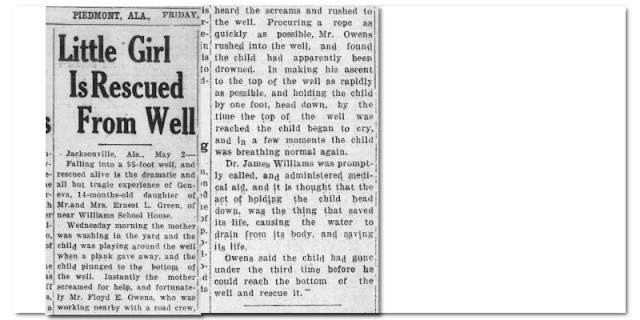
    Little Girl is Rescued from Well, Williams, 1930

    Little Girl Is Rescued From Well

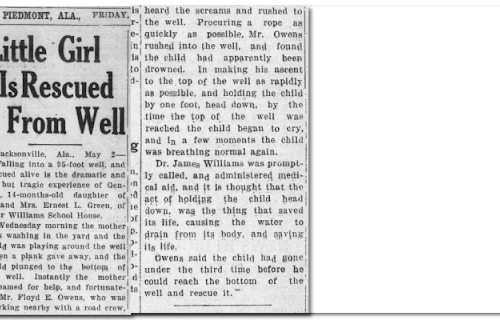
    Jacksonville, Ala., May 2– Falling into a 95-foot well, and rescued alive is the dramatic and all but tragic experience of Geneva, 14-months-old daughter of Mr. and Mrs. Ernest L. Green of near Williams School House.
    Wednesday morning, the mother was washing in the yard and the child was playing around the well when a plank gave away, and the child plunged to the bottom of the well. Instantly the mother screamed for help, and fortunately Mr. Floyd E. Owens, who was working nearby with a road crew, heard the screams and rushed to the well. Procuring a rope as quickly as possible, Mr. Owens rushed into the well, and found the child had apparently been drowned. In making his ascent to the top of the well as rapidly as possible, and holding the child by one foot, head down, by the time the top of the well was reached the child began to cry, and in a few moments the child was breathing normal again.
    Dr. James Williams was promptly called, and administered medical aid, and it is thought that the act of holding the child head down was the thing that saved its life, causing the water to drain from its body and saving its life.
    Owens said the child had gone under the third time before he could reach the bottom of the well and rescue it.


    PIEDMONT JOURNAL FRIDAY MAY, 1930

  • Alabama Type,  In Memory

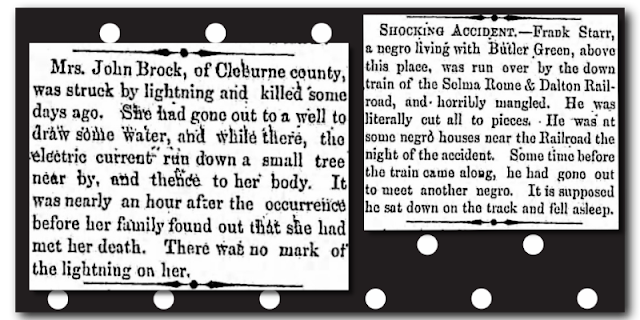
    Catastrophe Strikes Twice, 1871

    Mrs. John Brock of Cleburne county, was struck by lightning and killed some says ago. She had gone out to a well to draw some water, and while there, the electric current run down a small tree near by, and thence to her body.It was nearly an hour after the occurrence before her family found out that she had met her death. There was no mark of lightning on her.

    SHOCKING ACCCIDENT. –Frank Starr, a negro living with Butler Green, above this place, was run over by the down train of the Selma Rome & Dalton Railroad, and horribly mangled. He was literally cut all to pieces. He was at some negro houses near the Railroad the night of the accident. Some time before the train came along, he had gone out to meet another negro. It is supposed he sat down on the track and fell asleep.


    JACKSONVILLE REPUBLICAN SATURDAY AUGUST 19, 1871

  • Alabama Type,  In Memory

    Passing of Kiziah Hudson, Jacksonville, 1879

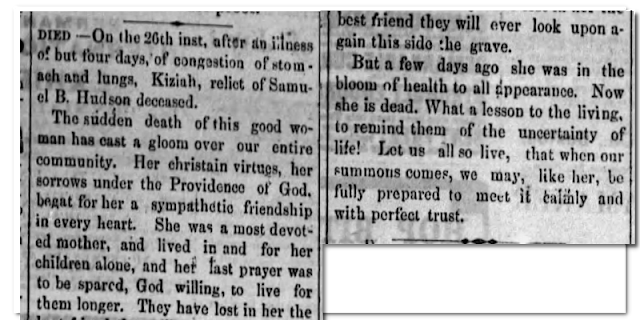
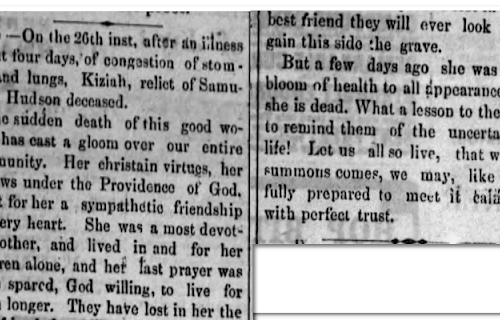
    DIED–On the 26th inst. after an illness of but four days, of congestion of stomach and lungs, Kiziah, relict of Samuel B. Hudson deceased.
    The sudden death of this good woman has cast a gloom over our entire community. Her Christian virtues, her sorrows under the Providence of God, begat for her a sympathetic friendship in every heart. She was a most devoted mother, and lived in and for her children alone, and her last prayer was to be spared, God willing, to live for them longer. They have lost in her the best friend they will ever look upon again this side of the grave.
    But a few days ago she was in the bloom of health to all appearance. Now she is dead. What a lesson to the living, to remind them of the uncertainty of Life! Let us all so live, that when our summons comes, we may, like her, be fully prepared to meet it calmly and with perfect trust.


    JACKSONVILLE REPUBLICAN, SAT JUNE, 1879

  • Alabama Type,  In Memory

    Death of W.M. Scott, Jacksonville, 1878

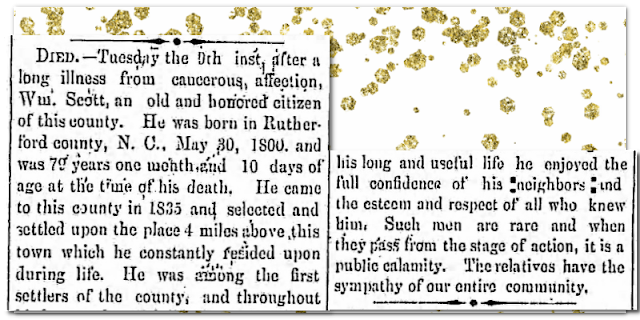
    DIED.–Tuesday the ?th inst, after a long illness from cancerous affection, Wm. Scott, an old and honored citizen of this county. He was born in Rutherford county, N.C., May 30th 1800. and was 79 years one month and 10 days of age at the time of his death. He came to this county in 1835 and selected and settled upon the place 4 miles above this town which he constantly resided upon during life. He was among the first settlers of the county, and throughout his long and useful life he enjoyed the full confidence of his neighbors and the esteem and respect of all who knew him. Such men are rare and when they pass from the stage of action, it is a public calamity. The relatives have the sympathy of our entire community.


    JACKSONVILLE REPUBLICAN, SATURDAY, JULY, 1878

  • Alabama Type,  Peculiar and Funny

    Cotton Thieves, Jacksonville 1890

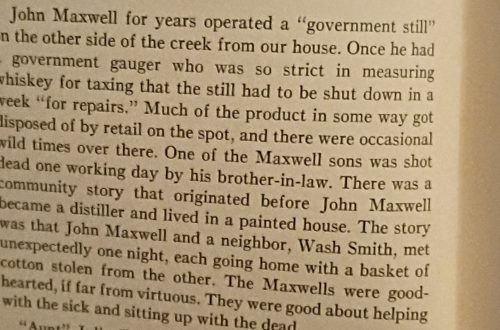
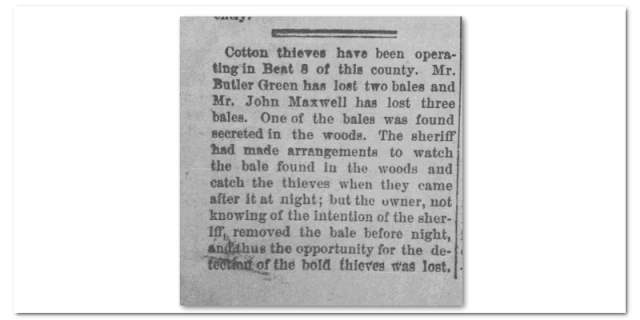
    Cotton thieves have been operating in Beat 8 of this county. Mr. Butler Green has lost two bales, and Mr. John Maxwell has lost three bales. One of the bales was found secreted in the woods. The sheriff had made arrangements to watch the bale found in the woods and catch the thieves when they came after it at night; but the owner, not knowing of the intention of the sheriff, removed the bale before night, and thus the opportunity for the detection of the bold thieves was lost.


    JACKSONVILLE REPUBLICAN SATURDAY JANUARY, 1890

  • Alabama Type,  In Memory

    A Young Lady Selects the Spot on Which she is Buried, Jacksonville 1890

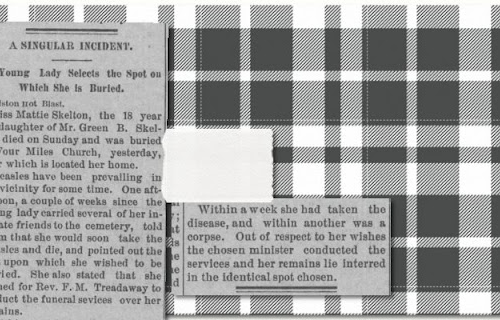
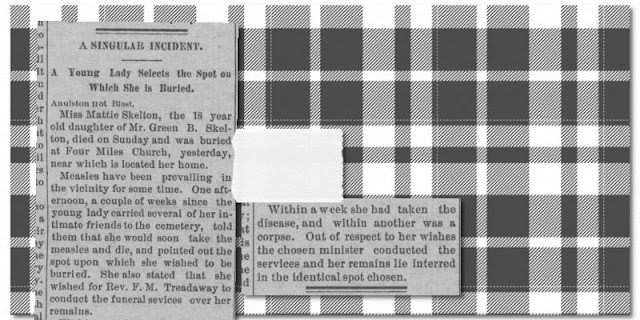
    A SINGULAR INCIDENT.

    A Young Lady Selects the Spot on Which she is Buried.
    Anniston Hot Blast.

    Miss Mattie Skelton, the 18 year old daughter of Mr. Green B. Skelton, died on Sunday and was buried at Four Miles Church, yesterday, near which is located her home.
    Measles have been prevailing in the vicinity for some time. One afternoon, a couple of weeks since the young lady carried several of her intimate friends to the cemetery, told them that she would soon take the measles and die, and pointed out the spot upon which she wished to be burried. She also stated that she wished for Rev. F.M. Treadaway to conduct the funeral services over her remains.
    Within a week she had taken the disease, and within another was a corpse. Out of respect to her wishes the chosen minister conducted the services and her remains lie interred in the identical spot chosen.

    JACKSONVILLE REPUBLICAN, SATURDAY, JULY, 1890

  • Alabama Type,  In Memory

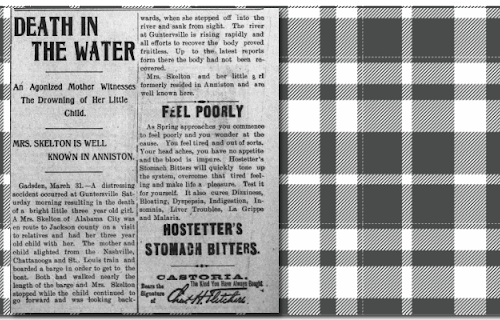
    Death in the Water, Jacksonville, 1904

    An Agonized Mother Witnesses The Drowning of Her Little Child

    MRS. SKELTON IS WELL KNOWN IN ANNISTON

    Gadsden, March 31. A distressing accident occurred at Guntersville Saturday morning resulting in the death of a bright little three year old girl. A Mrs. Skelton of Alabama City was en route to Jackson county on a visit to relatives and had her three year old child with her. The mother and child alighted from the Nashville, Chattanooga, and St. Louis train and boarded a barge in order to get to the boat. Both had walked nearly the length of the barge and Mrs. Skelton stopped while the child continued to go forward and was looking backwards, when she stepped off into the river and sank from sight. The river at Guntersville is rising rapidly and all efforts to recover the body proved fruitless. Up to the latest reports from there, the body had not been recovered.
    Mrs. Skelton and her little girl formerly resided in Anniston and are well known here.


    THE ANNISTON STAR FRIDAY APRIL, 1904
    DEATH IN THE WATER

  • Alabama Type,  Peculiar and Funny

    Annoying the Shoemakers, Piedmont, 1891

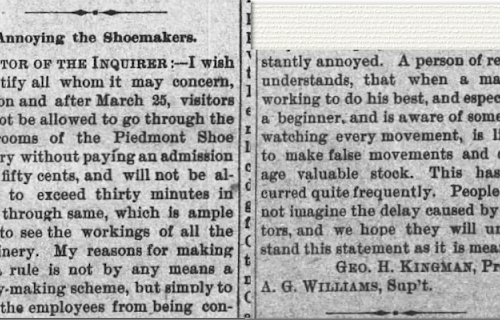
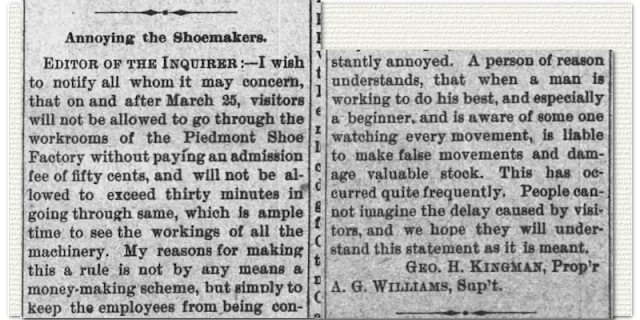
    EDITOR OF THE INQUIRER : – I wish to notify all whom it may concern, that on and after March 25, visitors will not be allowed to go through the workroom of the Piedmont Shoe Factory without paying an admission fee of fifty cents, and will not be allowed to exceed thirty minutes in going through same, which is ample time to see the workings of all the machinery. My reasons for making this a rule is not by any means a money-making scheme, but simply to keep the employees from being constantly annoyed. A person of reason understands, that when a man is working to do his best, and especially a beginner, and is aware of some one watching every movement, is liable to make false movements and damage valuable stock. This has occurred quite frequently. People cannot imagine the delay caused by visitors, and we hope they will understand this statement as it is meant.
    GEO. H. KINGMAN, Prop’r A.G. WILLIAMS, Sup’t.


    PIEDMONT INQUIRER, THURSDAY, MARCH,1891
    Annoying the Shoemakers.

  • Alabama Type,  Peculiar and Funny

    Mr. Boll Weevil + the Farmers’ Foot Race | Prices Switch, 1932

    Notes from Prices Switch, October, 1932

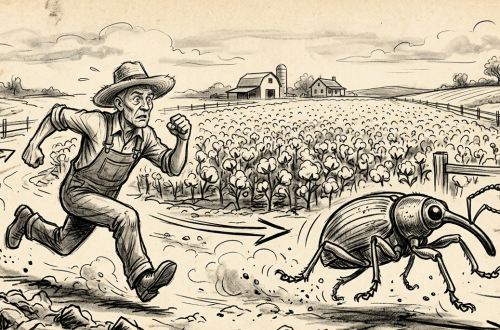
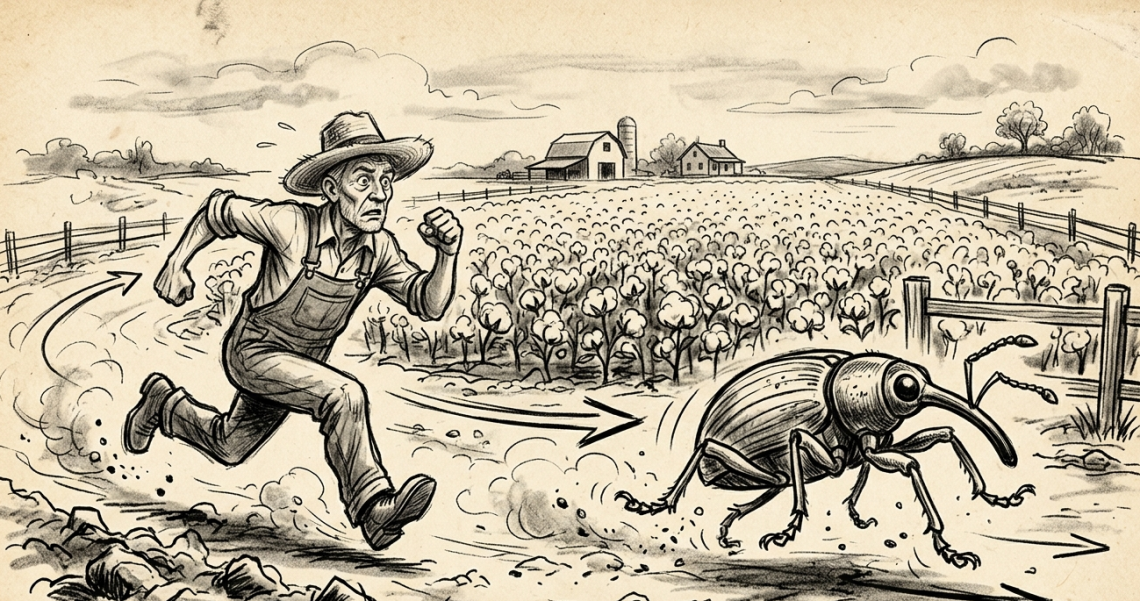
    • The health here is very good, except headache and colds. The weather has changed from real hot to very cool. Look for frost soon. The farmers and Mr. Boll Weevil are racing to see who can gather the cotton crop first.
    • Several of our neighbors took dinner with James Garrett Sunday, it being his 58th birthday. Jim and I are not as young now as we were 50 years ago. Not as good either as we were when our father used to play a tune with “hickory” on our legs, and we had to dance to the music. It was no enjoyment to dance at that time.
    • Miss Ruth Summers of Birmingham is visiting relatives at Maxwellborn. Mr. Summers section will extend to Prices Switch after Friday.
    • We notice that our editor is bringing up some very interesting old records from Jacksonville and surrounding country. We surely do love to see the old things in print. Some day we will see our old friends and loved ones who are almost forgotten. Thank you, Mr. Johnson. ‘Tis a great improvement in our paper. I hope to write something about the old times in the future.
    • Mr. Booler, our peddler, said he was badly disappointed week before last when The Journal arrived and the deacon was absent. Every subscriber likes the Prices Switch News, and we love them all. We would like to go into every home every week, but some people are so contrary that they won’t subscribe for the paper, but are your best friends to borrow the paper every week. We are glad to lend, but think they oughta subscribe.
    • Mr. John Jackson is building a house to live in. He says it is impossible to rent, and when a fellow can’t stay in the other fellow’s house he’d better get a tent.
    • Work had better open up. Farmers will soon be out of a job. Then what?

    PIEDMONT JOURNAL, FRIDAY, OCTOBER, 1932
    Princes Switch News

  • Alabama Type

    ‘Tot’ Smith’s Seen It All ‘Come And Go’ , Possum Trot, 1968

    “Well, I’ve seen this old country come and go.” The man laughed his quick, bright laugh and leaned forward in his chair until he seemed to rest on his knobby cane.

    The kitchen boasted a new refrigerator and stove, and three tall jars of beans stood on a large space heater. As he talked, chickens pecked the ground outside the screen door.
    Nathan W. Smith (his neighbors call him “Tot”) has lived all his life in Possum Trot—and that goes back at least 85 years.

    “It mostly looks like its been for the good,” he said. “I bought this in ’21 and cleaned it up—it was all in the woods, and now it’s in the woods again. Shoot-fire, I can’t help it, I can’t drive a nail, I can’t look up.”

    The house had been anchored to the steep hillside, and the narrow upper reach of the valley stretched out beneath it.

    “I made good cotton,” he said. “I don’t know how I managed to make a bale. One year I counted 25 weevils to the bloom, and if you didn’t poison them, the blooms would never pop.”

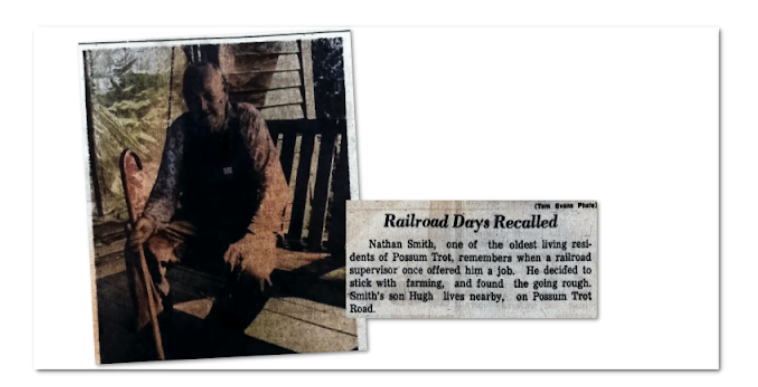
    Smith came close to following a railroad career instead of farming. A supervisor, impressed with his strength, tried to talk him into taking a job with promise of quick promotion.

    ” ‘If you take a railroad job,’ he said, ‘I’ll tell you what I’ll do. I’ll go back to my office and send you ‘prentice wages from the first lick you hit. Then, in six months, I’ll give you a section.” He looked like a bale of cotton out there walking down the tracks–he said he never saw nobody dress slag like me. He knew I knew railroads. I turned it down.”

    Smith said that as cotton farming moved west, leaving the South in the position of a jilted bride, timber raising increasingly filled the void.

    “Our land here will grow timber nearly as good as it will cotton. Pulpwood beats anything I ever saw growing, and those quick-growth pines are the same. On that bottom land, where it can get moisture, it gets away from you. It looks pretty foolish, I’ll tell you, a man out plowing pines,” he laughed.
    “It’s got where you can’t buy no land now. It used to be you could buy and sell it, but now there’s none to buy.”
    “I could have had a town here by now,” he said. “I could have sold it by the acre and let them build a house on it. Some people ask me why I didn’t. But you might get somebody in here you don’t like, and then you couldn’t get them out!”

    Smith said that with the decrease in small farms in the region had come a shortage of hired hands. A back injury prevents him from any longer working his own land, and yet no one can be found to work it for him.

    **Caption: Nathan Smith, one of the oldest living residents of Possom Trot, remembers when a railroad supervisor once offered him a job. He decided to stick with farming, and found the going rough. Smith’s son Hugh lives nearby, on Possum Trot Road.

    THE ANNISTON STAR, FRIDAY, NOVEMBER , 1968
    ‘Tot’ Smith’s Seen It All ‘Come And Go’
    By: Tom King
    SIXTH OF A SERIES

    **You may leave a virtual flower for Mr. Smith and learn more about him on his Find-a-Grave page here.