• Alabama Type

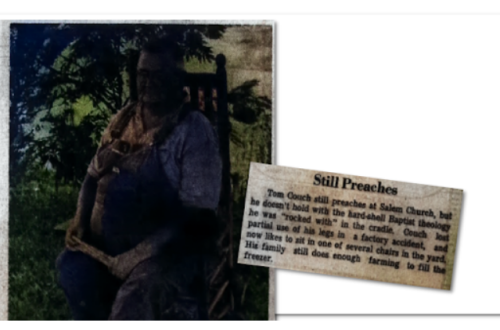
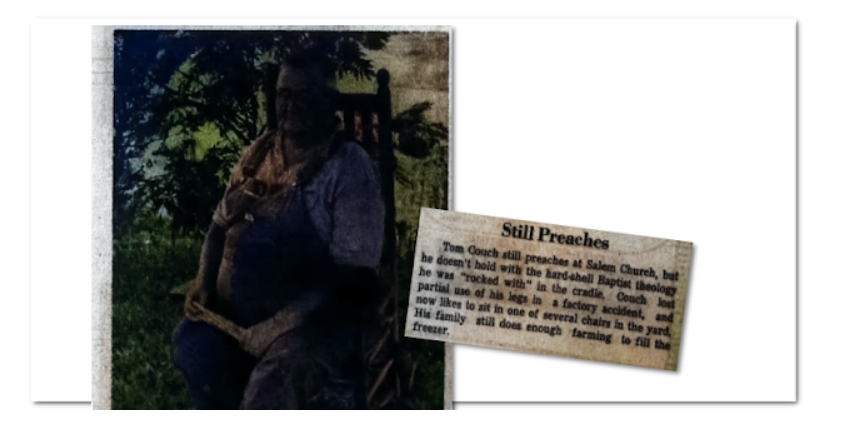
    Tom Couch, Salem Church, Possum Trot, 1968

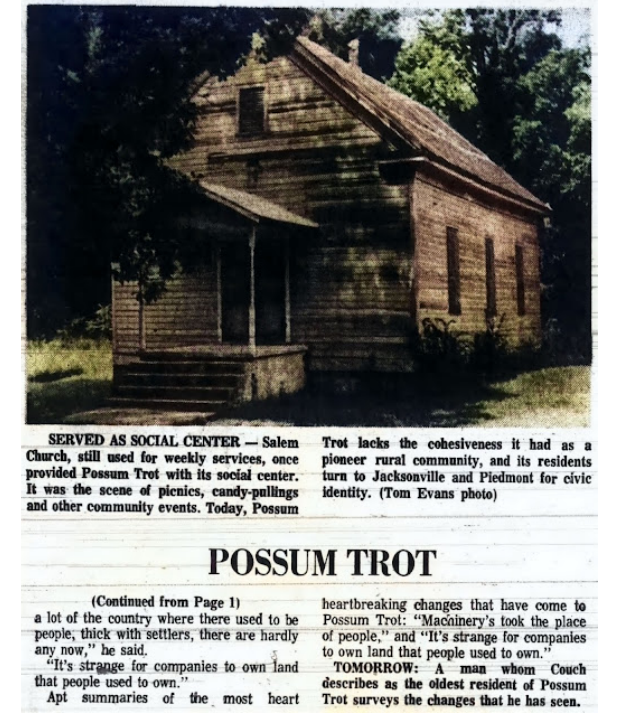
    Salem Church has been a Possum Trot landmark since its construction more than 80 years ago.
    In the interim, it has sheltered Presbyterian and Holiness services, as well as at least one generation of schoolchildren. Perhaps irresistible, its role as a social center has diminished.
    The Salem Presbyterians were the first to break the rigid custom of seating men and women on separate sides of the aisle, and in the 1880s and ’90s the church often served as the site of picnics, box suppers, candy-pullings and all-day singing.
    The present Holiness congregation still holds four services a week, but this organic function in the life of the community undeniably has come to an end.
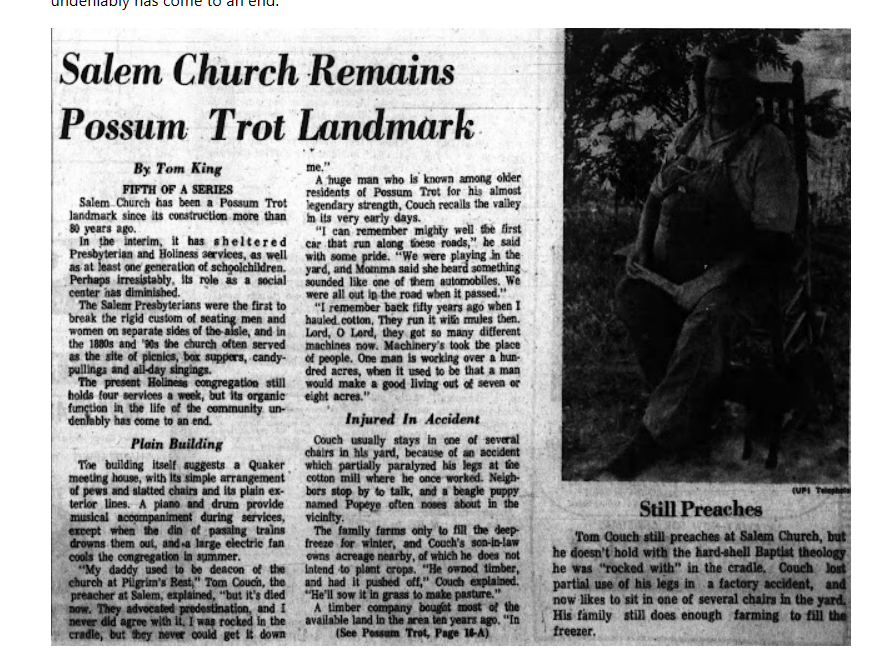
    Plain Building
    The building itself suggests a Quaker meeting house, with its simple arrangement of pews and slatted chairs and its plain exterior lines. A piano and drum provide musical accompaniment during services, except when the din of passing trains drowns them out, and a large electric fan cools the congregation in summer.

    “My daddy used to be a deacon of the church at Pilgrim’s Rest,” Tom Couch, the preacher at Salem, explained, “but it’s died now. They advocated predestination, and I never did agree with it. I was rocked in the cradle, but they never could get it down me.”

    A huge man who is known among older resides of Possum Trot for his almost legendary strength, Couch recalls the valley in its very early days.

    “I can remember mighty well the first car that run along these roads,” he said with some pride. “We were playing int he yard, and Momma said she heard something sounded like one of them automobiles. We were all out in the road when it passed.”
    “I remember back fifty years ago when I hauled cotton. They run it with mules then. Lord, O Lord, they got so many different machines now. Machinery’s took the place of people. One man is working over a hundred acres when it used to be that a man would make a good living out of seven or eight acres.”
    Injured In Accident
    Couch usually stays in one of several chairs in his yard, because of an accident which partially paralyzed his legs at the cotton mill where he once worked. Neighbors stop by to talk, and a beagle puppy named Popeye often noses about in the vicinity.
    The family farms only to fill the deep freeze for winter, and Couch’s son-in-law owns acreage nearby, of which he does not intend to plant crops.

    “He owned timber and hade it pushed off,” Couch explained. “He’ll sow it in grass to make a pasture.”
    A timber company bought most of the available land in the area ten years ago. “In a lot of the country where there used to be people, thick with settlers, there are hardly any now,” he said.
    “It’s strange for companies to own land that people used to own.”
    Apt summaries of the most heart heartbreaking changes that have come to Possum Trot: “Machinery’s took the place of people,” and “It’s strange for companies to own land that people used to own.”


    Still Preaches
    Tom Couch still preaches at Salem Church, but he doesn’t hold with the hard-shell Baptist theology he was “rocked with” in the cradle. Couch lost partial use of his legs in a factory accident, and now likes to sit in one of several chairs in the yard. His family still does enough farming to fill the freezer.


    SERVED AS SOCIAL CENTER– Salem Church, still used for weekly services, once provided Possum Trot with its social center. It was the scene of picnics, candy-pullings and other community events. Today, Possum Trot lacks the Cohesiveness it had as a pioneer rural community, and its residents turn to Jacksonville and Piedmont for civic identity. (Tom Evans photo)

    THE ANNISTON STAR, THURSDAY NOVEMBER, 1968
    Salem Church Remains Possum Trot Landmark
    By: Tom King
    FIFTH OF A SERIES
  • Alabama Type,  Peculiar and Funny

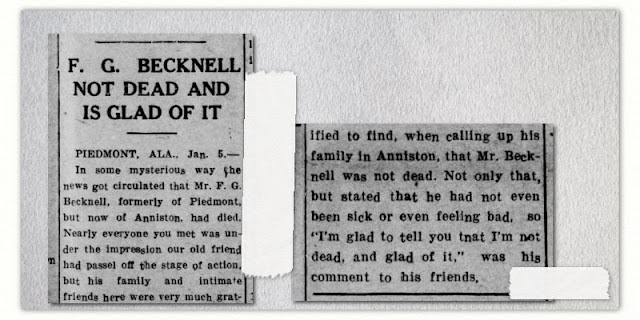
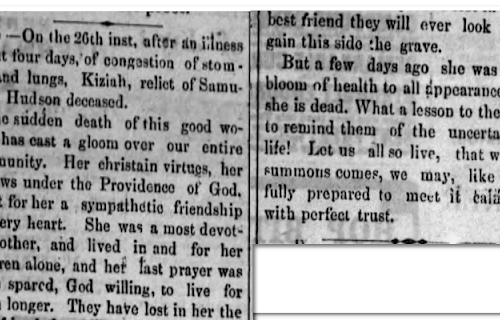
    F.G. BECKNELL NOT DEAD AND IS GLAD OF IT PIEDMONT, ALA. , Jan. 5.

    In some mysterious way the news got circulated that Mr. F.G. Becknell, formerly of Piedmont, but now of Anniston, had died. Nearly everyone you met was under the impression our old friend had passed off the stage of action, but his family and intimate friends here were very much gratified to find when calling up his family in Anniston, that Mr. Becknell was not dead. Not only that, but stated that he had not even been sick or even feeling bad, so “I’m glad to tell you that I’m not dead, and glad of it,” was his comment to his friends.


    F.G. BECKNELL NOT DEAD AND IS GLAD OF IT
    PIEDMONT, ALA. , Jan. 5.

    THE JACKSONVILLE RECORD, FRIDAY, JANUARY, 1933

  • Alabama Type

    1902 | The Duke of Merrellton, Jason Scott, suffered from granulated eyelids

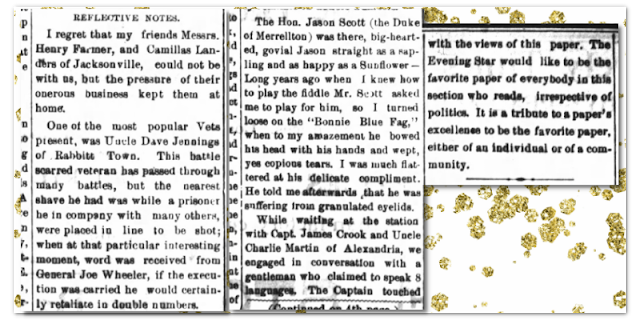
    I regret that my friends Messrs. Henry Farmer, and Camillas Landers of Jacksonville, could not be with us, but the presence of their onerous business kept them at home.

    One of the most popular Vets present, was Uncle Dave Jennings of Rabbitt Town. This battle scarred veteran has passed through many battles, but the nearest shave he had was while a prisoner he in company with many others, were placed in line to be shot; when at that particular interesting moment, word was received from General Joe Wheeler, if the execution was carried he would certainly retaliate in double numbers.

    The Hon. Jason Scott (the Duke of Merrellton) was there, big-hearted, govial Jason straight as a saplling and as happy as a sunflower–
    Long years ago when I knew how to play the fiddle Mr. Scott asked me to play for him, so I turned loose on the “Bonnie Blue Flag,” when to my amazement he bowed his head with his hands and wept, yes copious tears. I was much flattered at his delicate compliment. He told me afterwards that he was suffering from granulated eyelids.

    While waiting at the station with Capt. James Crook and Uncle Charlie Martin of Alexandria, we engaged in conversation with a gentleman who claimed to speak 8 languages. The captain touched with the views of this paper. The Evening Star would like to be the favorite paper of everybody in this section who reads, irrespective of politics. It is a tribute to a paper’s excellence to be the favorite paper, either of an individual or of a community.


    THE ANNISTON STAR, WEDNESDAY, AUGUST,1902
    An excerpt, notes from Camp Forney Veteerans’ Reunion, REFLECTIVE NOTES.

    ***In case you’ve never heard ‘My Bonnie Blue Flag’, you can listen to one version of it here. 

  • Alabama Type,  bibliophound

    Possum Trot, Herman Clarence Nixon, 1941

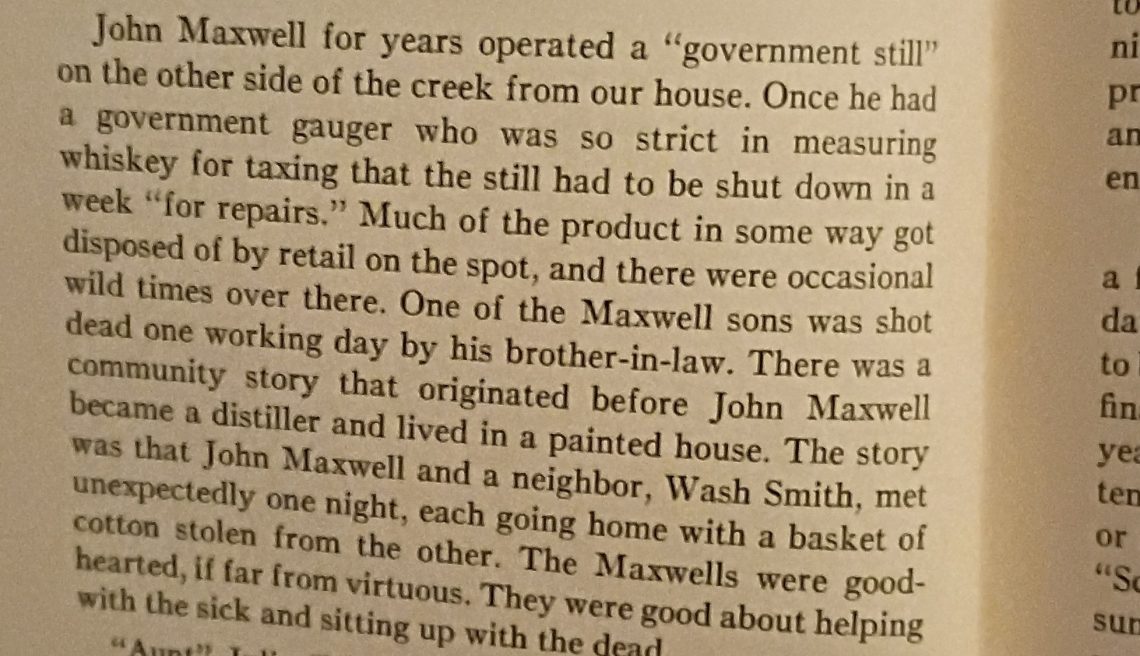
    ‘John Maxwell for years operated a ‘government still’ on the other side of the creek from our house. Once he had a government gauger who was so strict in measuring whiskey for taxing that the still had to be shut down in a week ‘for repairs.’ Much of the product in some way got disposed of by retail on the spot, and there were occasional wild times over there. One of the Maxwell sons was shot dead one working day by his brother-in-law. There was a community story that originated before John Maxwell became a distiller and lived in a painted house. The story was that John Maxwell and a neighbor, Wash Smith, met unexpectedly one night, each going home with a basket of stolen cotton from the other. The Maxwells were goodhearted, if far from virtuous. They were good about helping with the sick and sitting up with the dead.’

    -Herman Clarence Nixon, Possum Trot, 1941

  • Alabama Type

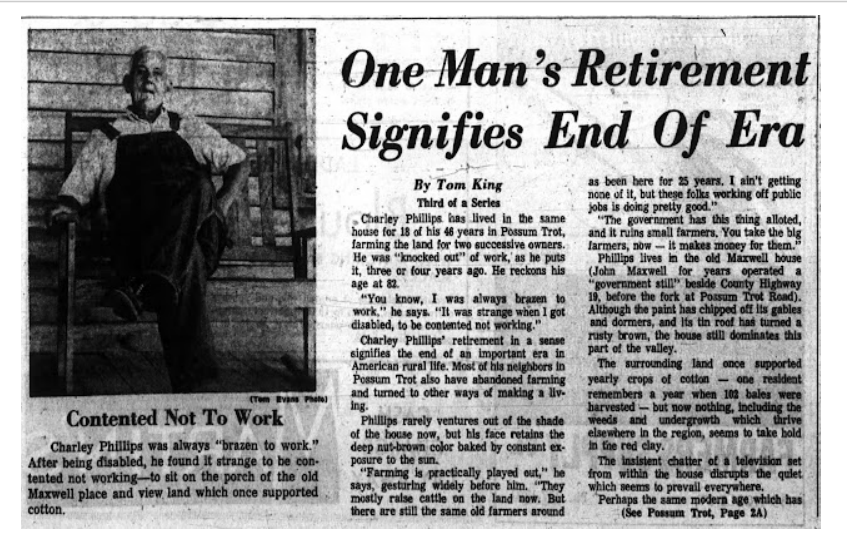
    One Man’s Retirement Signifies End of Era, Possum Trot, 1968

    Charley Phillips has lived in the same house for 18 of his 46 years in Possum Trot, farming the land for two successive owners. He was “knocked out” of work, as he puts it, three or four years ago. He reckons his age is 82.

    “You know, I was always brazen to work,” he says. “It was strange when I got disabled, to be contented not working.”

    Charley Phillips’ retirement in a sense signifies the end of an important era in American rural life. Most of his neighbors in Possum Trot, also have abandoned farming and turned to other ways of making a living.
    Phillips rarely ventures out of the shade of the house now, but his face retains the deep nut-brown color baked by constant exposure to the sun.

    “Farming is practically played out,” he says, gesturing widely before him. “They mostly raise cattle on the land now. But there are still the same old farmers around as been here for 25 years. I ain’t getting none of it, but these folks working off public jobs is doing pretty good.”
    “The government has this thing allotted, and it ruins small farmers. You take the big farmers, now–it makes money for them.”

    Phillips lives in the old Maxwell house (John Maxwell for years operated a “government still” beside County Highway 19, before the fork at Possum Trot Road). Although the paint has chipped off its gables and dormers, and its tin roof has turned a rusty brown, the house still dominates this part of the valley.
    The surrounding land once supported yearly crops of cotton–one resident remembers a year when 102 bales were harvested–but now nothing, including the weeds and undergrown which thrive elsewhere in the region, seems to take hold of the red clay.
    The insistent chatter of a television set from within the house disrupts the quiet which seems to prevail everywhere.
    Perhaps the same modern age which has outmoded Charley Phillips’ way of getting a living has also invented devices which make it easier “to be contented not working”.
    One of the few small farms left in Possum Trot belongs to Lloyd Kiker, whose income still consists mainly of the salary he earns as an employee of the county board of education.
    The life of his family curiously combines the old and new in Possum Trot–the farm-oriented society of three decades ago, and the city-oriented society of today.


    THE ANNISTON STAR, NOVEMBER, 1968

    One Man’s Retirement Signifies End of Era    By: Tom King

  • Alabama Type

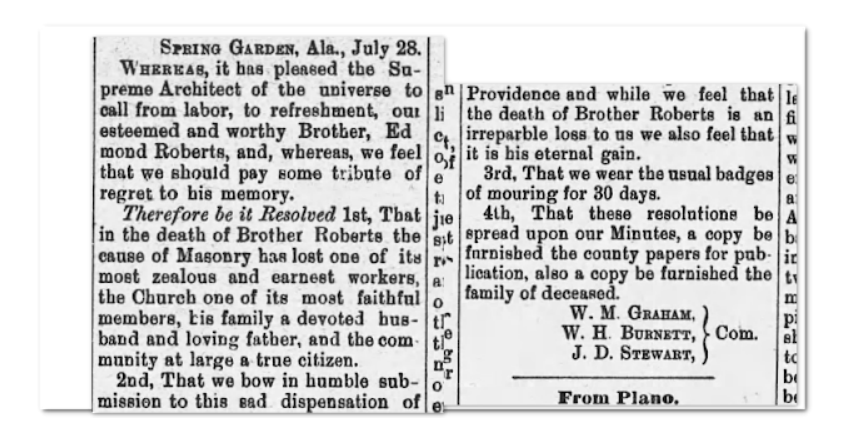
    News about Brother Edmond Roberts, Spring Garden, 1889


    THE COOSA RIVER NEWS, AUGUST, 1889

    SPRING GARDEN, ALa., July 28.

    WHEREAS, it has pleased the Supreme Architect of the universe to call from labor, to refreshment, our esteemed and worthy Brother, Edmond Roberts, and, whereas, we feel that we should pay some tribute of regret to his memory.
    Therefore be it Resolved 1st, That in the death of Brother Roberts the cause of Masonry has lost one of its most zealous and earnest workers, the church one of its most faithful members, his family a devoted husband and loving father, and the community at large a true citizen.
    2nd, That we bow in humble submission to this sad dispensation of Providence and while we feel that the death of Brother Roberts is an irreparable loss to us we also feel that it is his eternal gain.
    3rd, That we wear the usual badges of mouring for 30 days.
    4th, That these resolutions be spread upon our Minutes, a copy be furnished the county papers for publication, also a copy be furnished the family of deceased.

    W.M. GRAHM, W.H. BURNETT, J.D. STEWART, com.