“Well, I’ve seen this old country come and go.” The man laughed his quick, bright laugh and leaned forward in his chair until he seemed to rest on his knobby cane.
The kitchen boasted a new refrigerator and stove, and three tall jars of beans stood on a large space heater. As he talked, chickens pecked the ground outside the screen door.
Nathan W. Smith (his neighbors call him “Tot”) has lived all his life in Possum Trot—and that goes back at least 85 years.
“It mostly looks like its been for the good,” he said. “I bought this in ’21 and cleaned it up—it was all in the woods, and now it’s in the woods again. Shoot-fire, I can’t help it, I can’t drive a nail, I can’t look up.”
The house had been anchored to the steep hillside, and the narrow upper reach of the valley stretched out beneath it.
“I made good cotton,” he said. “I don’t know how I managed to make a bale. One year I counted 25 weevils to the bloom, and if you didn’t poison them, the blooms would never pop.”
Smith came close to following a railroad career instead of farming. A supervisor, impressed with his strength, tried to talk him into taking a job with promise of quick promotion.
” ‘If you take a railroad job,’ he said, ‘I’ll tell you what I’ll do. I’ll go back to my office and send you ‘prentice wages from the first lick you hit. Then, in six months, I’ll give you a section.” He looked like a bale of cotton out there walking down the tracks–he said he never saw nobody dress slag like me. He knew I knew railroads. I turned it down.”
Smith said that as cotton farming moved west, leaving the South in the position of a jilted bride, timber raising increasingly filled the void.
“Our land here will grow timber nearly as good as it will cotton. Pulpwood beats anything I ever saw growing, and those quick-growth pines are the same. On that bottom land, where it can get moisture, it gets away from you. It looks pretty foolish, I’ll tell you, a man out plowing pines,” he laughed.
“It’s got where you can’t buy no land now. It used to be you could buy and sell it, but now there’s none to buy.”
“I could have had a town here by now,” he said. “I could have sold it by the acre and let them build a house on it. Some people ask me why I didn’t. But you might get somebody in here you don’t like, and then you couldn’t get them out!”
Smith said that with the decrease in small farms in the region had come a shortage of hired hands. A back injury prevents him from any longer working his own land, and yet no one can be found to work it for him.
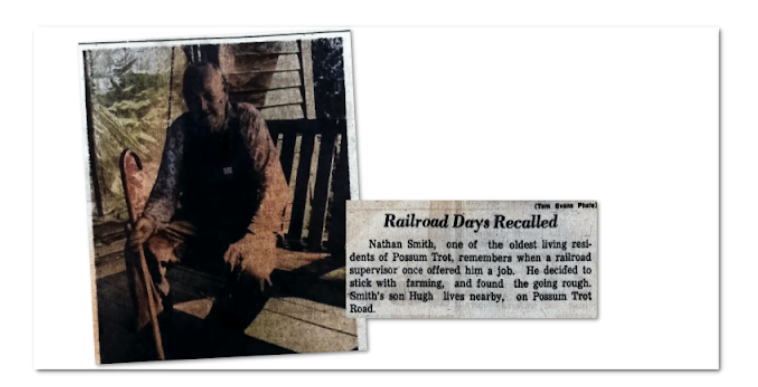
**Caption: Nathan Smith, one of the oldest living residents of Possom Trot, remembers when a railroad supervisor once offered him a job. He decided to stick with farming, and found the going rough. Smith’s son Hugh lives nearby, on Possum Trot Road.
THE ANNISTON STAR, FRIDAY, NOVEMBER , 1968
‘Tot’ Smith’s Seen It All ‘Come And Go’
By: Tom King
SIXTH OF A SERIES
**You may leave a virtual flower for Mr. Smith and learn more about him on his Find-a-Grave page here.