• Alabama Type,  bibliophound

    he had lived hard and in his own view had deserved all his fields, if not more

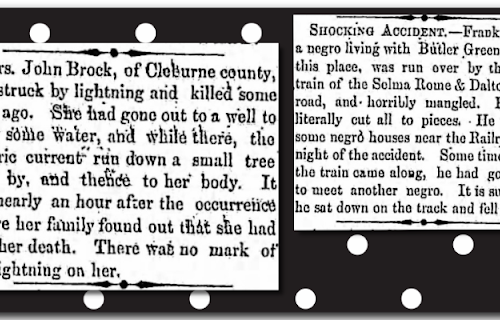
    ‘A gentle afternoon rain was falling as his funeral procession left the house a house which he had built, and moved down the road between fields of cotton. The cotton fields, his and his tenants, were clean of grass and well advanced in growth. The silent rain made them look their best and seemingly beg for their master’s approval as he moved by for the last time. This he would not have otherwise, for he had always liked to look at good crops of cotton, especially if they were his. One of his keenest joys was to show his “brag” patches to visitors, and all the patches seemed to be “brag” patches today, and there were more visitors than ever…he had lived hard and in his own view had deserved all his fields, if not more.’

    -Herman Clarence Nixon, Possum Trot (via Sarah Newman Shouse’s (1986) book ‘Hillbilly Realist Herman Clarence Nixon of Possum Trot’.)

  • Alabama Type,  Peculiar and Funny

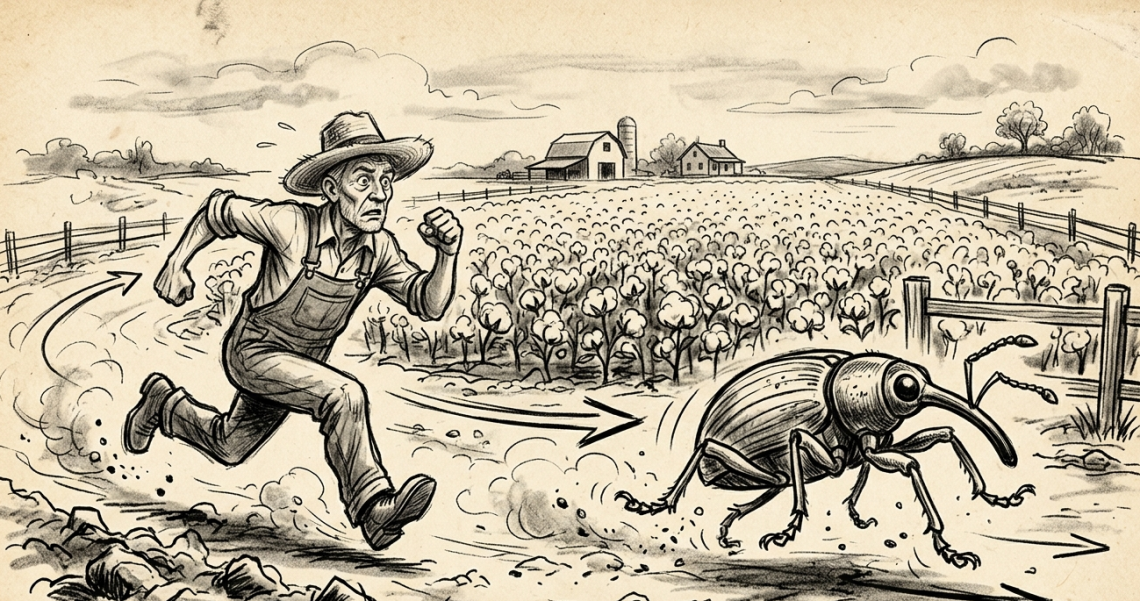
    Mr. Boll Weevil + the Farmers’ Foot Race | Prices Switch, 1932

    Notes from Prices Switch, October, 1932

    • The health here is very good, except headache and colds. The weather has changed from real hot to very cool. Look for frost soon. The farmers and Mr. Boll Weevil are racing to see who can gather the cotton crop first.
    • Several of our neighbors took dinner with James Garrett Sunday, it being his 58th birthday. Jim and I are not as young now as we were 50 years ago. Not as good either as we were when our father used to play a tune with “hickory” on our legs, and we had to dance to the music. It was no enjoyment to dance at that time.
    • Miss Ruth Summers of Birmingham is visiting relatives at Maxwellborn. Mr. Summers section will extend to Prices Switch after Friday.
    • We notice that our editor is bringing up some very interesting old records from Jacksonville and surrounding country. We surely do love to see the old things in print. Some day we will see our old friends and loved ones who are almost forgotten. Thank you, Mr. Johnson. ‘Tis a great improvement in our paper. I hope to write something about the old times in the future.
    • Mr. Booler, our peddler, said he was badly disappointed week before last when The Journal arrived and the deacon was absent. Every subscriber likes the Prices Switch News, and we love them all. We would like to go into every home every week, but some people are so contrary that they won’t subscribe for the paper, but are your best friends to borrow the paper every week. We are glad to lend, but think they oughta subscribe.
    • Mr. John Jackson is building a house to live in. He says it is impossible to rent, and when a fellow can’t stay in the other fellow’s house he’d better get a tent.
    • Work had better open up. Farmers will soon be out of a job. Then what?

    PIEDMONT JOURNAL, FRIDAY, OCTOBER, 1932
    Princes Switch News

  • Alabama Type

    ‘Tot’ Smith’s Seen It All ‘Come And Go’ , Possum Trot, 1968

    “Well, I’ve seen this old country come and go.” The man laughed his quick, bright laugh and leaned forward in his chair until he seemed to rest on his knobby cane.

    The kitchen boasted a new refrigerator and stove, and three tall jars of beans stood on a large space heater. As he talked, chickens pecked the ground outside the screen door.
    Nathan W. Smith (his neighbors call him “Tot”) has lived all his life in Possum Trot—and that goes back at least 85 years.

    “It mostly looks like its been for the good,” he said. “I bought this in ’21 and cleaned it up—it was all in the woods, and now it’s in the woods again. Shoot-fire, I can’t help it, I can’t drive a nail, I can’t look up.”

    The house had been anchored to the steep hillside, and the narrow upper reach of the valley stretched out beneath it.

    “I made good cotton,” he said. “I don’t know how I managed to make a bale. One year I counted 25 weevils to the bloom, and if you didn’t poison them, the blooms would never pop.”

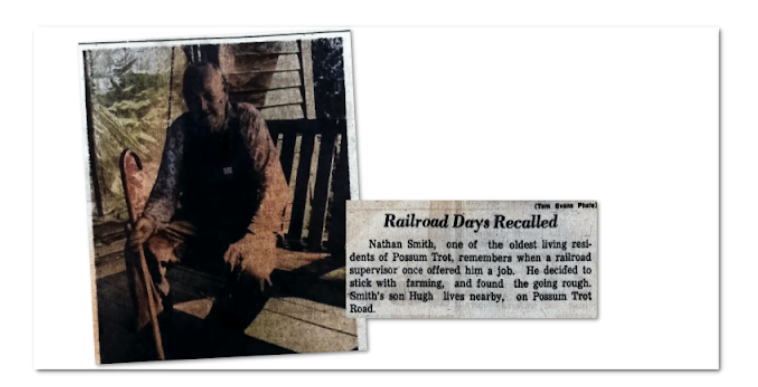
    Smith came close to following a railroad career instead of farming. A supervisor, impressed with his strength, tried to talk him into taking a job with promise of quick promotion.

    ” ‘If you take a railroad job,’ he said, ‘I’ll tell you what I’ll do. I’ll go back to my office and send you ‘prentice wages from the first lick you hit. Then, in six months, I’ll give you a section.” He looked like a bale of cotton out there walking down the tracks–he said he never saw nobody dress slag like me. He knew I knew railroads. I turned it down.”

    Smith said that as cotton farming moved west, leaving the South in the position of a jilted bride, timber raising increasingly filled the void.

    “Our land here will grow timber nearly as good as it will cotton. Pulpwood beats anything I ever saw growing, and those quick-growth pines are the same. On that bottom land, where it can get moisture, it gets away from you. It looks pretty foolish, I’ll tell you, a man out plowing pines,” he laughed.
    “It’s got where you can’t buy no land now. It used to be you could buy and sell it, but now there’s none to buy.”
    “I could have had a town here by now,” he said. “I could have sold it by the acre and let them build a house on it. Some people ask me why I didn’t. But you might get somebody in here you don’t like, and then you couldn’t get them out!”

    Smith said that with the decrease in small farms in the region had come a shortage of hired hands. A back injury prevents him from any longer working his own land, and yet no one can be found to work it for him.

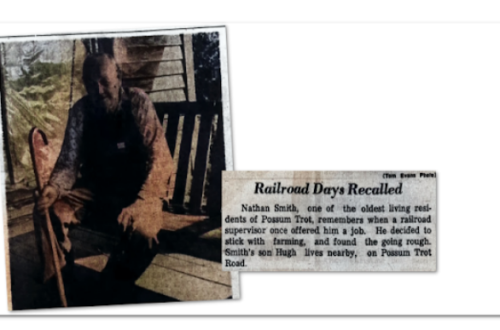
    **Caption: Nathan Smith, one of the oldest living residents of Possom Trot, remembers when a railroad supervisor once offered him a job. He decided to stick with farming, and found the going rough. Smith’s son Hugh lives nearby, on Possum Trot Road.

    THE ANNISTON STAR, FRIDAY, NOVEMBER , 1968
    ‘Tot’ Smith’s Seen It All ‘Come And Go’
    By: Tom King
    SIXTH OF A SERIES

    **You may leave a virtual flower for Mr. Smith and learn more about him on his Find-a-Grave page here. 
  • Alabama Type

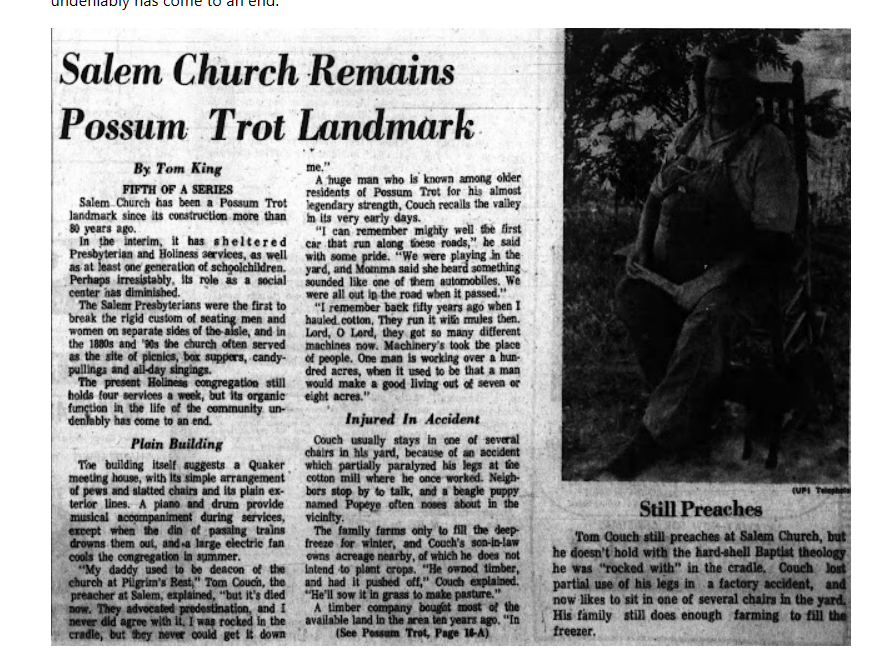
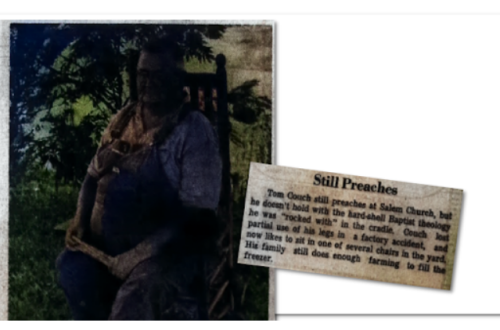
    Tom Couch, Salem Church, Possum Trot, 1968

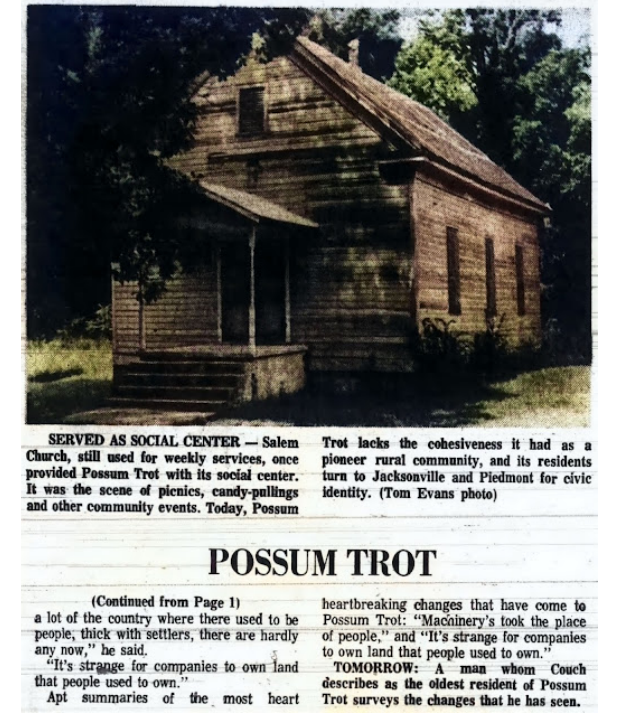
    Salem Church has been a Possum Trot landmark since its construction more than 80 years ago.
    In the interim, it has sheltered Presbyterian and Holiness services, as well as at least one generation of schoolchildren. Perhaps irresistible, its role as a social center has diminished.
    The Salem Presbyterians were the first to break the rigid custom of seating men and women on separate sides of the aisle, and in the 1880s and ’90s the church often served as the site of picnics, box suppers, candy-pullings and all-day singing.
    The present Holiness congregation still holds four services a week, but this organic function in the life of the community undeniably has come to an end.

    Plain Building
    The building itself suggests a Quaker meeting house, with its simple arrangement of pews and slatted chairs and its plain exterior lines. A piano and drum provide musical accompaniment during services, except when the din of passing trains drowns them out, and a large electric fan cools the congregation in summer.

    “My daddy used to be a deacon of the church at Pilgrim’s Rest,” Tom Couch, the preacher at Salem, explained, “but it’s died now. They advocated predestination, and I never did agree with it. I was rocked in the cradle, but they never could get it down me.”

    A huge man who is known among older resides of Possum Trot for his almost legendary strength, Couch recalls the valley in its very early days.

    “I can remember mighty well the first car that run along these roads,” he said with some pride. “We were playing int he yard, and Momma said she heard something sounded like one of them automobiles. We were all out in the road when it passed.”
    “I remember back fifty years ago when I hauled cotton. They run it with mules then. Lord, O Lord, they got so many different machines now. Machinery’s took the place of people. One man is working over a hundred acres when it used to be that a man would make a good living out of seven or eight acres.”

    Injured In Accident
    Couch usually stays in one of several chairs in his yard, because of an accident which partially paralyzed his legs at the cotton mill where he once worked. Neighbors stop by to talk, and a beagle puppy named Popeye often noses about in the vicinity.
    The family farms only to fill the deep freeze for winter, and Couch’s son-in-law owns acreage nearby, of which he does not intend to plant crops.

    “He owned timber and hade it pushed off,” Couch explained. “He’ll sow it in grass to make a pasture.”
    A timber company bought most of the available land in the area ten years ago. “In a lot of the country where there used to be people, thick with settlers, there are hardly any now,” he said.
    “It’s strange for companies to own land that people used to own.”
    Apt summaries of the most heart heartbreaking changes that have come to Possum Trot: “Machinery’s took the place of people,” and “It’s strange for companies to own land that people used to own.”


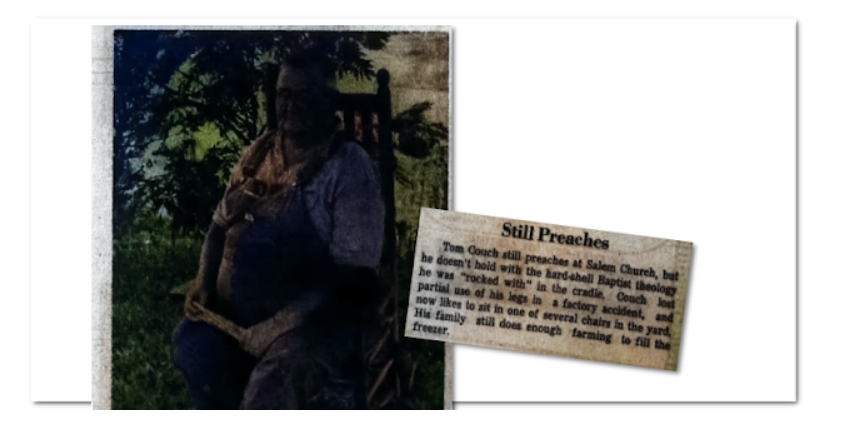
    Still Preaches
    Tom Couch still preaches at Salem Church, but he doesn’t hold with the hard-shell Baptist theology he was “rocked with” in the cradle. Couch lost partial use of his legs in a factory accident, and now likes to sit in one of several chairs in the yard. His family still does enough farming to fill the freezer.


    SERVED AS SOCIAL CENTER– Salem Church, still used for weekly services, once provided Possum Trot with its social center. It was the scene of picnics, candy-pullings and other community events. Today, Possum Trot lacks the Cohesiveness it had as a pioneer rural community, and its residents turn to Jacksonville and Piedmont for civic identity. (Tom Evans photo)

    THE ANNISTON STAR, THURSDAY NOVEMBER, 1968
    Salem Church Remains Possum Trot Landmark
    By: Tom King
    FIFTH OF A SERIES

  • Alabama Type,  bibliophound

    Possum Trot, Herman Clarence Nixon, 1941

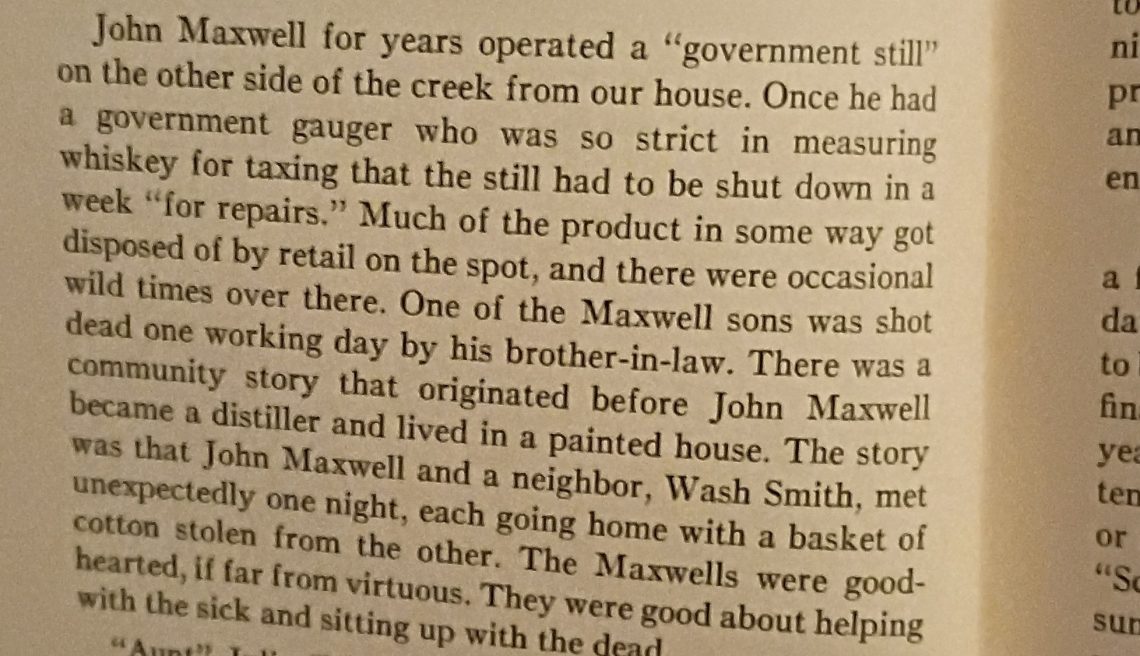
    ‘John Maxwell for years operated a ‘government still’ on the other side of the creek from our house. Once he had a government gauger who was so strict in measuring whiskey for taxing that the still had to be shut down in a week ‘for repairs.’ Much of the product in some way got disposed of by retail on the spot, and there were occasional wild times over there. One of the Maxwell sons was shot dead one working day by his brother-in-law. There was a community story that originated before John Maxwell became a distiller and lived in a painted house. The story was that John Maxwell and a neighbor, Wash Smith, met unexpectedly one night, each going home with a basket of stolen cotton from the other. The Maxwells were goodhearted, if far from virtuous. They were good about helping with the sick and sitting up with the dead.’

    -Herman Clarence Nixon, Possum Trot, 1941

  • Alabama Type

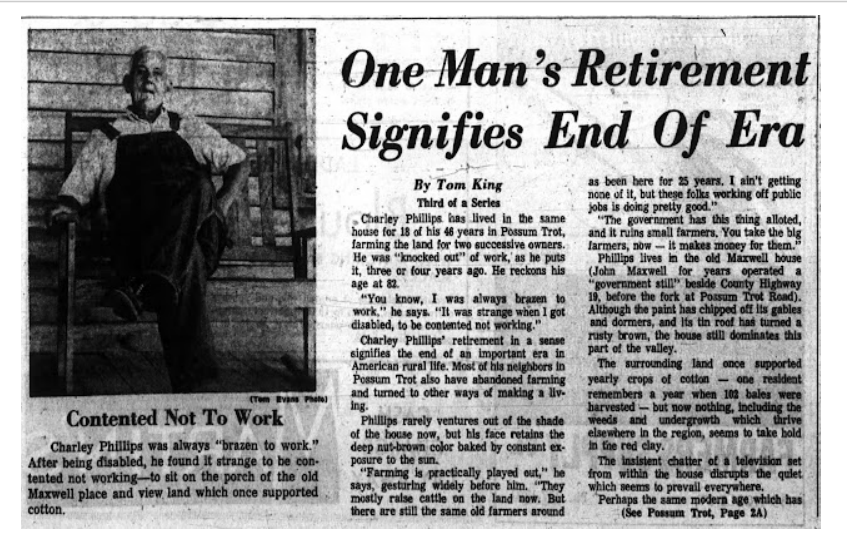
    One Man’s Retirement Signifies End of Era, Possum Trot, 1968

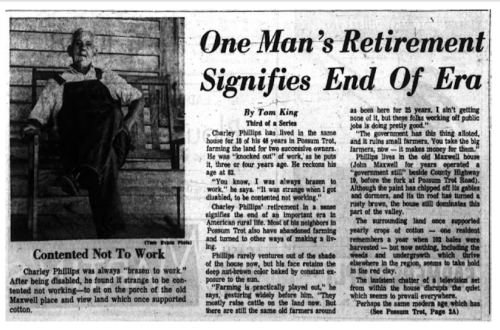
    Charley Phillips has lived in the same house for 18 of his 46 years in Possum Trot, farming the land for two successive owners. He was “knocked out” of work, as he puts it, three or four years ago. He reckons his age is 82.

    “You know, I was always brazen to work,” he says. “It was strange when I got disabled, to be contented not working.”

    Charley Phillips’ retirement in a sense signifies the end of an important era in American rural life. Most of his neighbors in Possum Trot, also have abandoned farming and turned to other ways of making a living.
    Phillips rarely ventures out of the shade of the house now, but his face retains the deep nut-brown color baked by constant exposure to the sun.

    “Farming is practically played out,” he says, gesturing widely before him. “They mostly raise cattle on the land now. But there are still the same old farmers around as been here for 25 years. I ain’t getting none of it, but these folks working off public jobs is doing pretty good.”
    “The government has this thing allotted, and it ruins small farmers. You take the big farmers, now–it makes money for them.”

    Phillips lives in the old Maxwell house (John Maxwell for years operated a “government still” beside County Highway 19, before the fork at Possum Trot Road). Although the paint has chipped off its gables and dormers, and its tin roof has turned a rusty brown, the house still dominates this part of the valley.
    The surrounding land once supported yearly crops of cotton–one resident remembers a year when 102 bales were harvested–but now nothing, including the weeds and undergrown which thrive elsewhere in the region, seems to take hold of the red clay.
    The insistent chatter of a television set from within the house disrupts the quiet which seems to prevail everywhere.
    Perhaps the same modern age which has outmoded Charley Phillips’ way of getting a living has also invented devices which make it easier “to be contented not working”.
    One of the few small farms left in Possum Trot belongs to Lloyd Kiker, whose income still consists mainly of the salary he earns as an employee of the county board of education.
    The life of his family curiously combines the old and new in Possum Trot–the farm-oriented society of three decades ago, and the city-oriented society of today.


    THE ANNISTON STAR, NOVEMBER, 1968

    One Man’s Retirement Signifies End of Era    By: Tom King