• Alabama Type,  Peculiar and Funny

    A Horse Scrape, 1889, Oxford

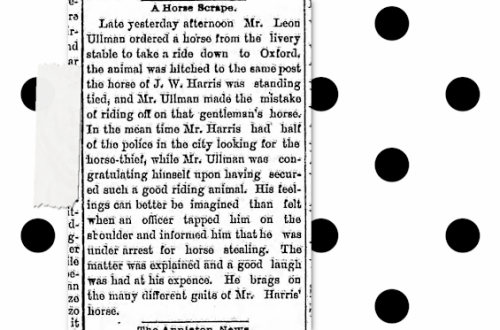
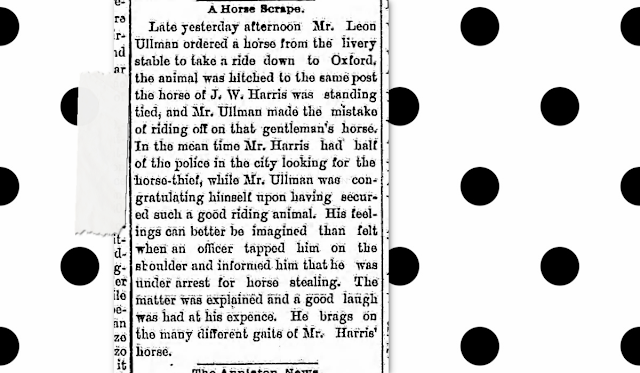
    A Horse Scrape.
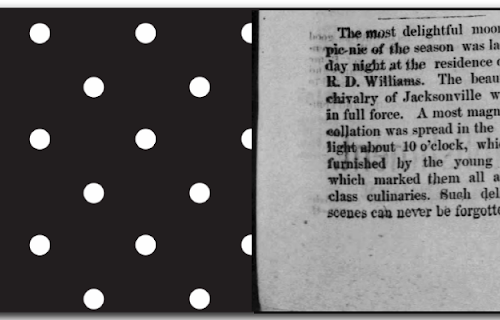
    Late yesterday afternoon Mr. Leon Ullman ordered a horse from the livery stable to take a ride down to Oxford. The animal was hitched to the same post the horse of J.W. Harris was standing tied, and Mr. Ullman made the mistake of riding off on that gentleman’s horse.
    In the mean time Mr. Harris had half of the police in the city looking for the horse-thief, while Mr. Ullman was congratulating himself upon having secured such a good riding animal. His feelings can better be imagined than felt when an officer tapped him on the shoulder and informed him that he was under arrest for horse stealing. The matter was explained and a good laugh was had at his expence. He brags on the many different gaits of Mr. Harris’ horse.


    THE EVENING NEWS, THURSDAY, MARCH 21, 1889

  • Alabama Type

    Little Girl is Rescued from Well, Williams, 1930

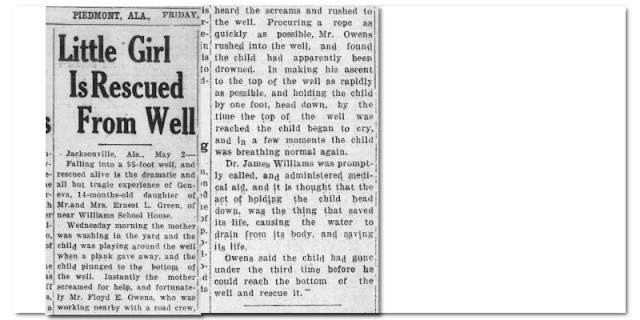
    Little Girl Is Rescued From Well

    Jacksonville, Ala., May 2– Falling into a 95-foot well, and rescued alive is the dramatic and all but tragic experience of Geneva, 14-months-old daughter of Mr. and Mrs. Ernest L. Green of near Williams School House.
    Wednesday morning, the mother was washing in the yard and the child was playing around the well when a plank gave away, and the child plunged to the bottom of the well. Instantly the mother screamed for help, and fortunately Mr. Floyd E. Owens, who was working nearby with a road crew, heard the screams and rushed to the well. Procuring a rope as quickly as possible, Mr. Owens rushed into the well, and found the child had apparently been drowned. In making his ascent to the top of the well as rapidly as possible, and holding the child by one foot, head down, by the time the top of the well was reached the child began to cry, and in a few moments the child was breathing normal again.
    Dr. James Williams was promptly called, and administered medical aid, and it is thought that the act of holding the child head down was the thing that saved its life, causing the water to drain from its body and saving its life.
    Owens said the child had gone under the third time before he could reach the bottom of the well and rescue it.


    PIEDMONT JOURNAL FRIDAY MAY, 1930

  • Alabama Type,  In Memory

    Passing of Kiziah Hudson, Jacksonville, 1879

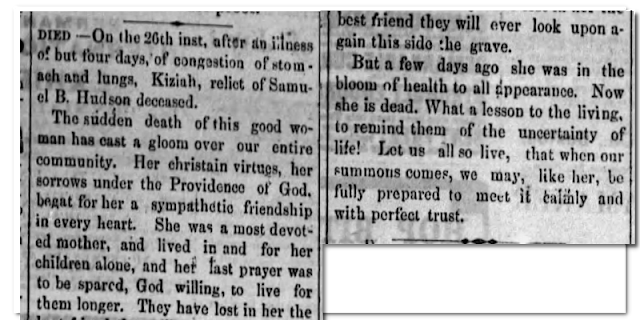
    DIED–On the 26th inst. after an illness of but four days, of congestion of stomach and lungs, Kiziah, relict of Samuel B. Hudson deceased.
    The sudden death of this good woman has cast a gloom over our entire community. Her Christian virtues, her sorrows under the Providence of God, begat for her a sympathetic friendship in every heart. She was a most devoted mother, and lived in and for her children alone, and her last prayer was to be spared, God willing, to live for them longer. They have lost in her the best friend they will ever look upon again this side of the grave.
    But a few days ago she was in the bloom of health to all appearance. Now she is dead. What a lesson to the living, to remind them of the uncertainty of Life! Let us all so live, that when our summons comes, we may, like her, be fully prepared to meet it calmly and with perfect trust.


    JACKSONVILLE REPUBLICAN, SAT JUNE, 1879

  • Alabama Type,  Peculiar and Funny

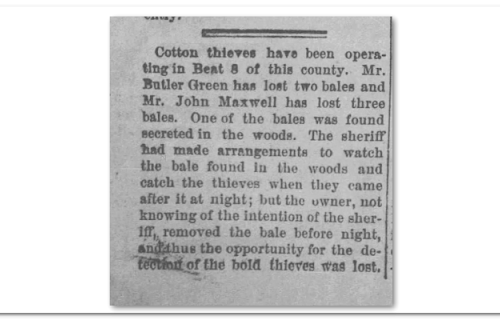
    Cotton Thieves, Jacksonville 1890

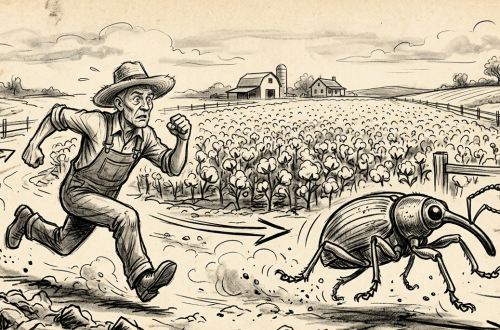
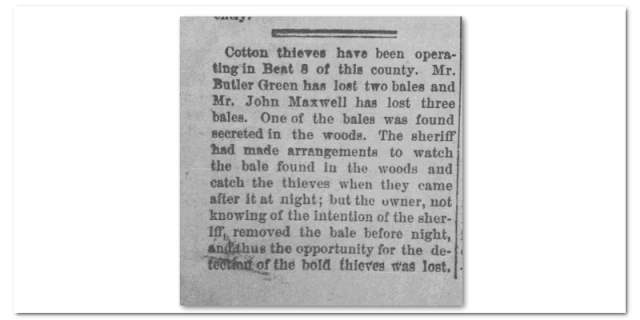
    Cotton thieves have been operating in Beat 8 of this county. Mr. Butler Green has lost two bales, and Mr. John Maxwell has lost three bales. One of the bales was found secreted in the woods. The sheriff had made arrangements to watch the bale found in the woods and catch the thieves when they came after it at night; but the owner, not knowing of the intention of the sheriff, removed the bale before night, and thus the opportunity for the detection of the bold thieves was lost.


    JACKSONVILLE REPUBLICAN SATURDAY JANUARY, 1890

  • Alabama Type,  Peculiar and Funny

    Annoying the Shoemakers, Piedmont, 1891

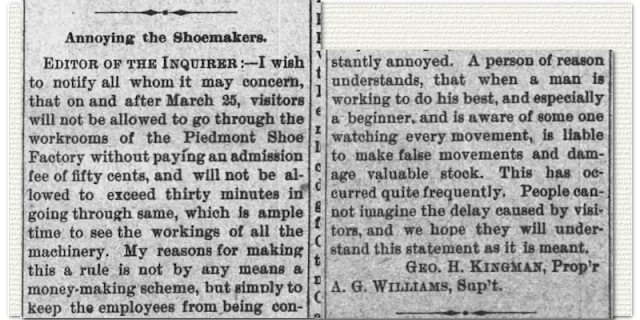
    EDITOR OF THE INQUIRER : – I wish to notify all whom it may concern, that on and after March 25, visitors will not be allowed to go through the workroom of the Piedmont Shoe Factory without paying an admission fee of fifty cents, and will not be allowed to exceed thirty minutes in going through same, which is ample time to see the workings of all the machinery. My reasons for making this a rule is not by any means a money-making scheme, but simply to keep the employees from being constantly annoyed. A person of reason understands, that when a man is working to do his best, and especially a beginner, and is aware of some one watching every movement, is liable to make false movements and damage valuable stock. This has occurred quite frequently. People cannot imagine the delay caused by visitors, and we hope they will understand this statement as it is meant.
    GEO. H. KINGMAN, Prop’r A.G. WILLIAMS, Sup’t.


    PIEDMONT INQUIRER, THURSDAY, MARCH,1891
    Annoying the Shoemakers.

  • Alabama Type

    ‘Tot’ Smith’s Seen It All ‘Come And Go’ , Possum Trot, 1968

    “Well, I’ve seen this old country come and go.” The man laughed his quick, bright laugh and leaned forward in his chair until he seemed to rest on his knobby cane.

    The kitchen boasted a new refrigerator and stove, and three tall jars of beans stood on a large space heater. As he talked, chickens pecked the ground outside the screen door.
    Nathan W. Smith (his neighbors call him “Tot”) has lived all his life in Possum Trot—and that goes back at least 85 years.

    “It mostly looks like its been for the good,” he said. “I bought this in ’21 and cleaned it up—it was all in the woods, and now it’s in the woods again. Shoot-fire, I can’t help it, I can’t drive a nail, I can’t look up.”

    The house had been anchored to the steep hillside, and the narrow upper reach of the valley stretched out beneath it.

    “I made good cotton,” he said. “I don’t know how I managed to make a bale. One year I counted 25 weevils to the bloom, and if you didn’t poison them, the blooms would never pop.”

    Smith came close to following a railroad career instead of farming. A supervisor, impressed with his strength, tried to talk him into taking a job with promise of quick promotion.

    ” ‘If you take a railroad job,’ he said, ‘I’ll tell you what I’ll do. I’ll go back to my office and send you ‘prentice wages from the first lick you hit. Then, in six months, I’ll give you a section.” He looked like a bale of cotton out there walking down the tracks–he said he never saw nobody dress slag like me. He knew I knew railroads. I turned it down.”

    Smith said that as cotton farming moved west, leaving the South in the position of a jilted bride, timber raising increasingly filled the void.

    “Our land here will grow timber nearly as good as it will cotton. Pulpwood beats anything I ever saw growing, and those quick-growth pines are the same. On that bottom land, where it can get moisture, it gets away from you. It looks pretty foolish, I’ll tell you, a man out plowing pines,” he laughed.
    “It’s got where you can’t buy no land now. It used to be you could buy and sell it, but now there’s none to buy.”
    “I could have had a town here by now,” he said. “I could have sold it by the acre and let them build a house on it. Some people ask me why I didn’t. But you might get somebody in here you don’t like, and then you couldn’t get them out!”

    Smith said that with the decrease in small farms in the region had come a shortage of hired hands. A back injury prevents him from any longer working his own land, and yet no one can be found to work it for him.

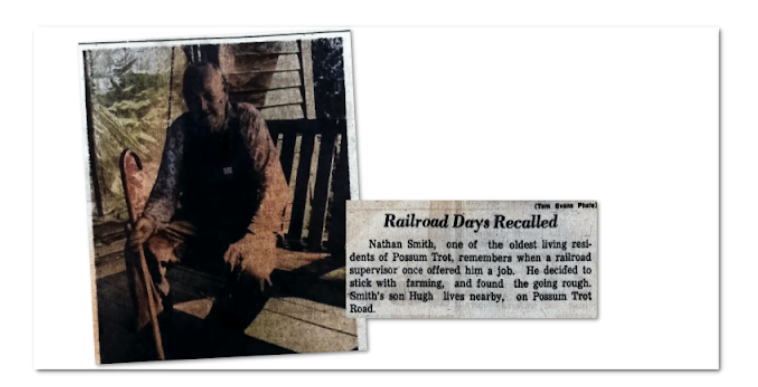
    **Caption: Nathan Smith, one of the oldest living residents of Possom Trot, remembers when a railroad supervisor once offered him a job. He decided to stick with farming, and found the going rough. Smith’s son Hugh lives nearby, on Possum Trot Road.

    THE ANNISTON STAR, FRIDAY, NOVEMBER , 1968
    ‘Tot’ Smith’s Seen It All ‘Come And Go’
    By: Tom King
    SIXTH OF A SERIES

    **You may leave a virtual flower for Mr. Smith and learn more about him on his Find-a-Grave page here. 
  • Alabama Type

    Tom Couch, Salem Church, Possum Trot, 1968

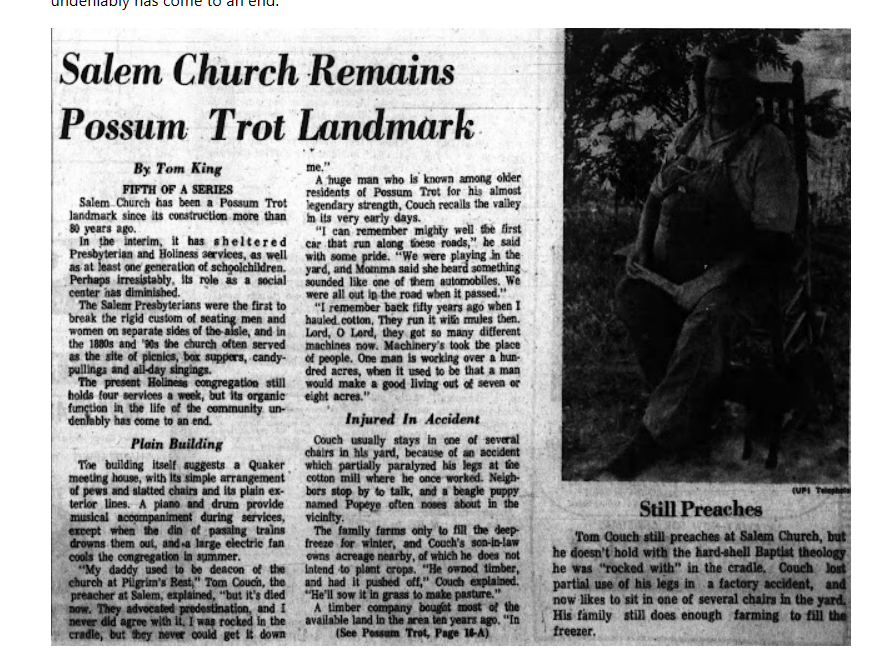
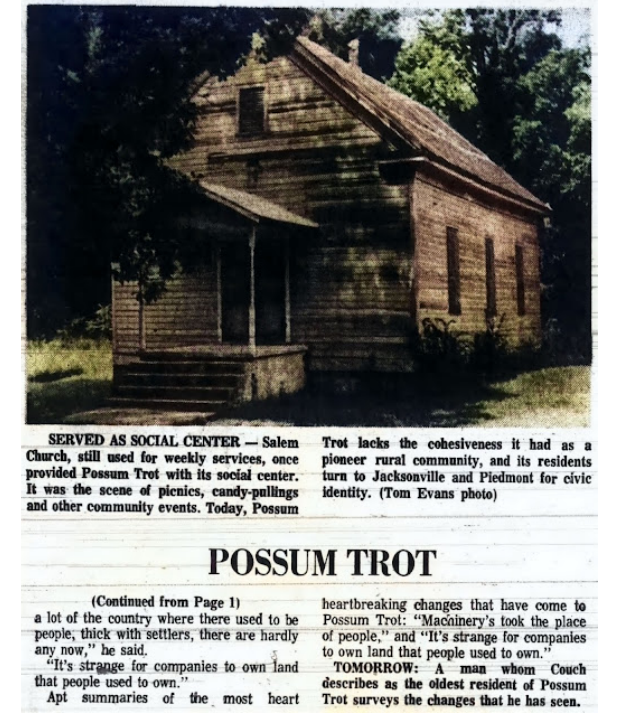
    Salem Church has been a Possum Trot landmark since its construction more than 80 years ago.
    In the interim, it has sheltered Presbyterian and Holiness services, as well as at least one generation of schoolchildren. Perhaps irresistible, its role as a social center has diminished.
    The Salem Presbyterians were the first to break the rigid custom of seating men and women on separate sides of the aisle, and in the 1880s and ’90s the church often served as the site of picnics, box suppers, candy-pullings and all-day singing.
    The present Holiness congregation still holds four services a week, but this organic function in the life of the community undeniably has come to an end.

    Plain Building
    The building itself suggests a Quaker meeting house, with its simple arrangement of pews and slatted chairs and its plain exterior lines. A piano and drum provide musical accompaniment during services, except when the din of passing trains drowns them out, and a large electric fan cools the congregation in summer.

    “My daddy used to be a deacon of the church at Pilgrim’s Rest,” Tom Couch, the preacher at Salem, explained, “but it’s died now. They advocated predestination, and I never did agree with it. I was rocked in the cradle, but they never could get it down me.”

    A huge man who is known among older resides of Possum Trot for his almost legendary strength, Couch recalls the valley in its very early days.

    “I can remember mighty well the first car that run along these roads,” he said with some pride. “We were playing int he yard, and Momma said she heard something sounded like one of them automobiles. We were all out in the road when it passed.”
    “I remember back fifty years ago when I hauled cotton. They run it with mules then. Lord, O Lord, they got so many different machines now. Machinery’s took the place of people. One man is working over a hundred acres when it used to be that a man would make a good living out of seven or eight acres.”

    Injured In Accident
    Couch usually stays in one of several chairs in his yard, because of an accident which partially paralyzed his legs at the cotton mill where he once worked. Neighbors stop by to talk, and a beagle puppy named Popeye often noses about in the vicinity.
    The family farms only to fill the deep freeze for winter, and Couch’s son-in-law owns acreage nearby, of which he does not intend to plant crops.

    “He owned timber and hade it pushed off,” Couch explained. “He’ll sow it in grass to make a pasture.”
    A timber company bought most of the available land in the area ten years ago. “In a lot of the country where there used to be people, thick with settlers, there are hardly any now,” he said.
    “It’s strange for companies to own land that people used to own.”
    Apt summaries of the most heart heartbreaking changes that have come to Possum Trot: “Machinery’s took the place of people,” and “It’s strange for companies to own land that people used to own.”


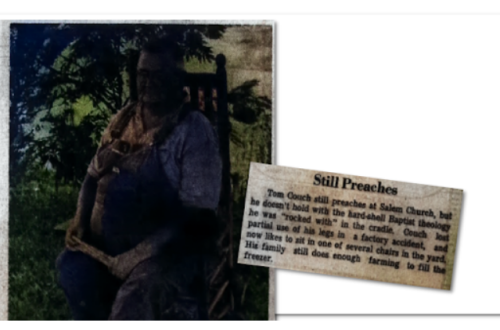
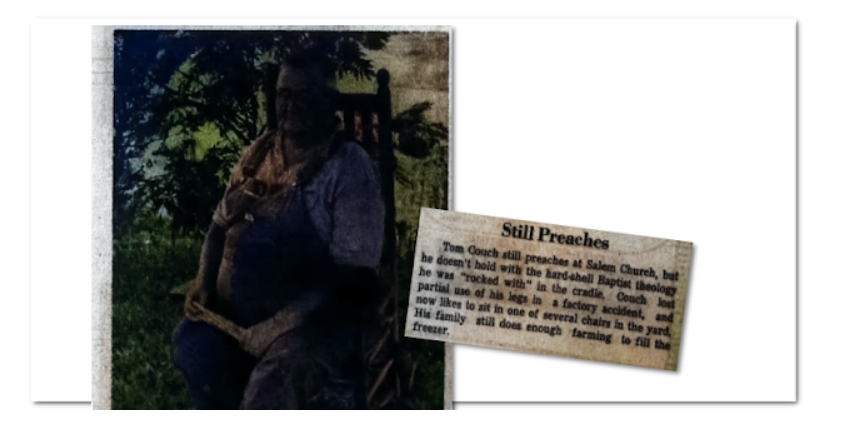
    Still Preaches
    Tom Couch still preaches at Salem Church, but he doesn’t hold with the hard-shell Baptist theology he was “rocked with” in the cradle. Couch lost partial use of his legs in a factory accident, and now likes to sit in one of several chairs in the yard. His family still does enough farming to fill the freezer.


    SERVED AS SOCIAL CENTER– Salem Church, still used for weekly services, once provided Possum Trot with its social center. It was the scene of picnics, candy-pullings and other community events. Today, Possum Trot lacks the Cohesiveness it had as a pioneer rural community, and its residents turn to Jacksonville and Piedmont for civic identity. (Tom Evans photo)

    THE ANNISTON STAR, THURSDAY NOVEMBER, 1968
    Salem Church Remains Possum Trot Landmark
    By: Tom King
    FIFTH OF A SERIES

  • Alabama Type

    1902 | The Duke of Merrellton, Jason Scott, suffered from granulated eyelids

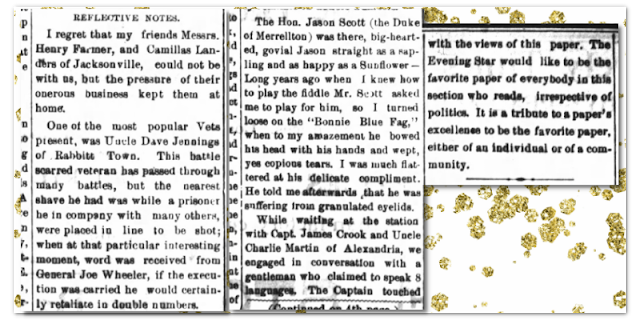
    I regret that my friends Messrs. Henry Farmer, and Camillas Landers of Jacksonville, could not be with us, but the presence of their onerous business kept them at home.

    One of the most popular Vets present, was Uncle Dave Jennings of Rabbitt Town. This battle scarred veteran has passed through many battles, but the nearest shave he had was while a prisoner he in company with many others, were placed in line to be shot; when at that particular interesting moment, word was received from General Joe Wheeler, if the execution was carried he would certainly retaliate in double numbers.

    The Hon. Jason Scott (the Duke of Merrellton) was there, big-hearted, govial Jason straight as a saplling and as happy as a sunflower–
    Long years ago when I knew how to play the fiddle Mr. Scott asked me to play for him, so I turned loose on the “Bonnie Blue Flag,” when to my amazement he bowed his head with his hands and wept, yes copious tears. I was much flattered at his delicate compliment. He told me afterwards that he was suffering from granulated eyelids.

    While waiting at the station with Capt. James Crook and Uncle Charlie Martin of Alexandria, we engaged in conversation with a gentleman who claimed to speak 8 languages. The captain touched with the views of this paper. The Evening Star would like to be the favorite paper of everybody in this section who reads, irrespective of politics. It is a tribute to a paper’s excellence to be the favorite paper, either of an individual or of a community.


    THE ANNISTON STAR, WEDNESDAY, AUGUST,1902
    An excerpt, notes from Camp Forney Veteerans’ Reunion, REFLECTIVE NOTES.

    ***In case you’ve never heard ‘My Bonnie Blue Flag’, you can listen to one version of it here.