• Alabama Type

    Heroic Act of Emmet Calhoun, age 9, 1905

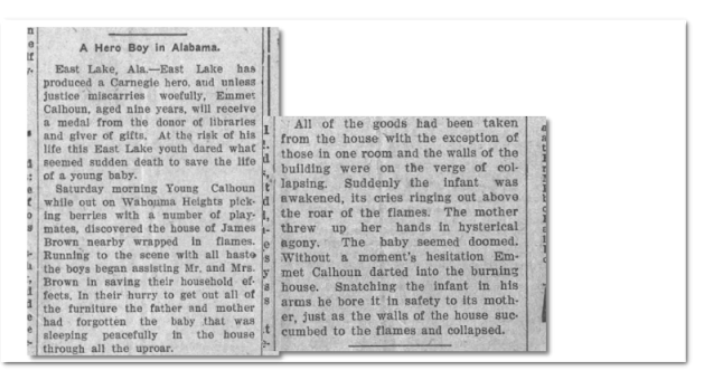
    A Hero Boy in Alabama.

    East Lake, Ala.–East Lake has produced a Carnegie hero, and unless justice miscarries woefully, Emmet Calhoun, aged nine years, will receive a medal from the honor of libraries and giver of gifts. At the risk of his own life this East Lake youth dared what seemed sudden death to save the life of a young baby.

    Saturday morning Young Calhoun while out on Wahouma Heights picking berries with a number of playmates, discovered the house of James Brown nearby wrapped in flames. Running to the scene with all haste the boys began assisting Mr. and Mrs. Brown in saving their household effects. In their hurry to get out all of the furniture the father and mother had forgotten the baby that was sleeping peacefully in the house through all the uproar.

    All of the goods had been taken from the house with the exception of those in one room and the walls of the building were on the verge of collapsing. Suddenly the infant was awakened, its cries ringing out above the roar of the flames. The mother threw up her hands in hysterical agony. The baby seemed doomed. Without a moment’s hesitation, Emmet Calhoun darted into the burning house. Snatching the infant in his arms he bored it in safety to its mother, just as the walls of the house succumbed to flames and collapsed.

    THE OPP HUSTLER, FRIDAY, 1905

  • Alabama Type,  In Memory

    Sad Death of Lawrence Journey, Jacksonville, 1903

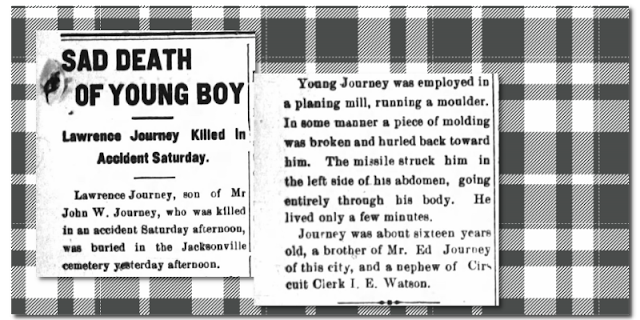
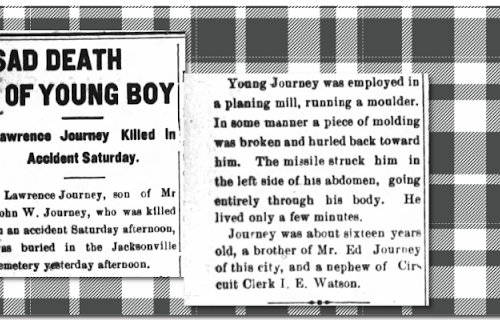
    SAD DEATH OF YOUNG BOY

    Lawrence Journey Killed in Accident Saturday.

    Lawrence Journey, son of Mr. John W. Journey, who was killed in an accident Saturday afternoon, was buried in the Jacksonville Cemetery yesterday afternoon.
    Young Journey was employed in a planing mill, running a moulder. In some manner, a piece of molding was broken and hurled back toward him. The missile struck him in the left side of his abdomen going entirely through his body. He lived only a few minutes.
    Journey was about sixteen years old, a brother of Mr. Ed Journey of this city, and a nephew of Circuit Clerk I.E. Watson.


    THE ANNISTON REPUBLIC, SATURDAY, SEPTEMBER 19TH, 1903

  • Alabama Type

    Sunday Afternoon Blaze, Piedmont, 1891

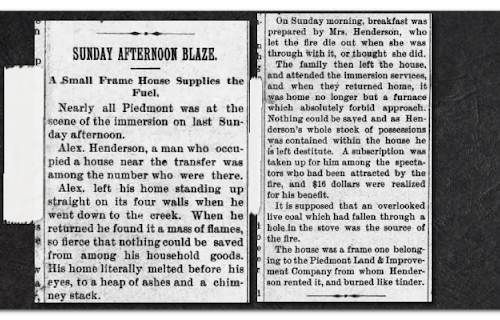
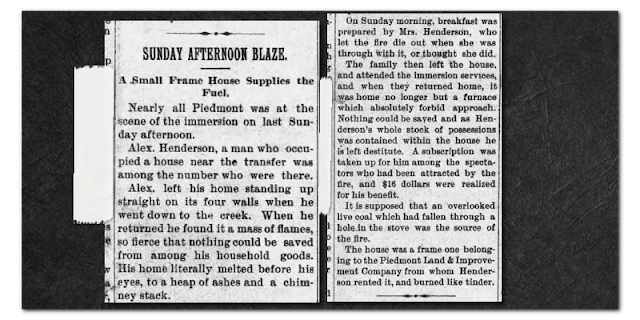
    SUNDAY AFTERNOON BLAZE.

    A Small Frame House Supplies the Fuel.

    Nearly all Piedmont was at the scene of the immersion on last Sunday afternoon.
    Alex Henderson, a man who occupied a house near the transfer was among the number who were there.
    Alex. left his home standing up straight on its four walls when he went down to the creek. When he returned he found it a mass of flames, so fierce that nothing could be saved from among his household goods. His home literally melted before his eyes, to a heap of ashes and a chimney stack.
    On Sunday morning, breakfast was prepared by Mrs. Henderson, who let the fire die out when she was through with it, or thought she did.
    The family then left the house, and attended the immersion services, and when they returned home, it was home no longer but a furnace which absolutely forbid approach. Nothing could be saved and as Henderson’s whole stock of possessions was contained within the house he is left destitute. A subscription was taken up for him among the spectators who had been attracted by the fire, and $16 dollars were realized for his benefit.
    It is supposed that an overlooked live coal which had fallen through a hole in the stove was the source of the fire.
    The house was a frame one belonging to the Piedmont Land & Improvement Company from whom Henderson rented it, and burned like tinder.

    PIEDMONT INQUIRER, SATURDAY OCTOBER 31, 1891

  • Alabama Type,  In Memory

    Mrs. Mae Ford, Jacksonville 1977

    ‘Family’ feeling fading in Jacksonville’s mill area

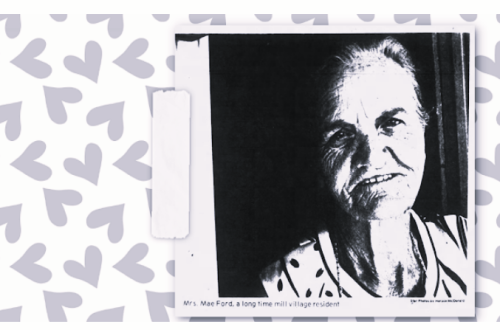
    Mrs. Mae Ford of 21 A St has lived in the village – to the west of the square and mostly down hill – more than 50 years.

    “I married here in the Methodist church in town and I’ve lived in number 4, 21, and 41,” she said “I’ve raised my family here and made my steps right in here.” the silver-haired woman said as she looked over some pictures of mill workers taken in 1906.
    “It’s the best neighborhood to live in,” she said “The older ones were just like a family. If one got in trouble, the others would go to help them.”

    Mrs. Ford raised six children in the village, not an unusual number for the 1930s and 1940s she said.

    “Everybody had five or six or seven children” she recalled “Nobody could afford anything for Christmas except for a red wagon for the whole family.
    “There’re no children around anymore.”

    Mrs. Ford worked in the Profile Cotton Mill for 34 years before she quit in 1955. “I spooled for 14 years. I also was an extra. I worked wherever they needed me. I’ve done everything in all the mills.”

    Mrs. Ford said living in a company-owned house was convenient.

    “It was close and handy,” she said “I could run out when I’d catch up with my work and check on my children. It was a good settlement.”

    Living in the village was also economical.
    Mrs. Ford worked when the company had an order and usually brought home $32 a month. Her late husband who also worked at the mill, made less than that for years she said.
    From their earnings, they paid the company $4.80 a month in rent and bought groceries at the Profile Store on B Street.
    What they didn’t buy, they raised in gardens, hog pens and company-owned cow pastures.

    “I just had a few tomatoes and cucumbers this year,” Mrs. Ford said. “When you get 74, it’s time to slow down. I still cut my grass though, and walk to town and church.”

    Also featured in the article:
    Jud Harrelson of 54 B st, James Jocko Martin of 1 A st, James Harbin of 94 c st, Mrs. Bertha Barnwell of 116 D st, Treda Bonds of 55 B st, Sandy Barnwell of 44 B st.

    THE ANNISTON STAR, 77 (Monde Murphy) Excerpt

  • Alabama Type

    ‘Tot’ Smith’s Seen It All ‘Come And Go’ , Possum Trot, 1968

    “Well, I’ve seen this old country come and go.” The man laughed his quick, bright laugh and leaned forward in his chair until he seemed to rest on his knobby cane.

    The kitchen boasted a new refrigerator and stove, and three tall jars of beans stood on a large space heater. As he talked, chickens pecked the ground outside the screen door.
    Nathan W. Smith (his neighbors call him “Tot”) has lived all his life in Possum Trot—and that goes back at least 85 years.

    “It mostly looks like its been for the good,” he said. “I bought this in ’21 and cleaned it up—it was all in the woods, and now it’s in the woods again. Shoot-fire, I can’t help it, I can’t drive a nail, I can’t look up.”

    The house had been anchored to the steep hillside, and the narrow upper reach of the valley stretched out beneath it.

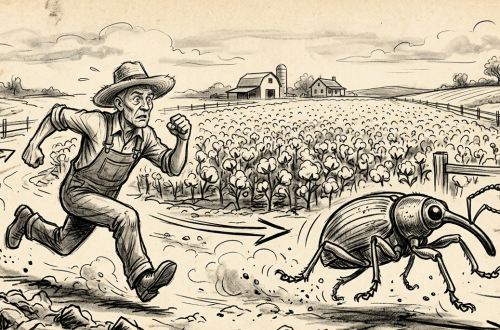
    “I made good cotton,” he said. “I don’t know how I managed to make a bale. One year I counted 25 weevils to the bloom, and if you didn’t poison them, the blooms would never pop.”

    Smith came close to following a railroad career instead of farming. A supervisor, impressed with his strength, tried to talk him into taking a job with promise of quick promotion.

    ” ‘If you take a railroad job,’ he said, ‘I’ll tell you what I’ll do. I’ll go back to my office and send you ‘prentice wages from the first lick you hit. Then, in six months, I’ll give you a section.” He looked like a bale of cotton out there walking down the tracks–he said he never saw nobody dress slag like me. He knew I knew railroads. I turned it down.”

    Smith said that as cotton farming moved west, leaving the South in the position of a jilted bride, timber raising increasingly filled the void.

    “Our land here will grow timber nearly as good as it will cotton. Pulpwood beats anything I ever saw growing, and those quick-growth pines are the same. On that bottom land, where it can get moisture, it gets away from you. It looks pretty foolish, I’ll tell you, a man out plowing pines,” he laughed.
    “It’s got where you can’t buy no land now. It used to be you could buy and sell it, but now there’s none to buy.”
    “I could have had a town here by now,” he said. “I could have sold it by the acre and let them build a house on it. Some people ask me why I didn’t. But you might get somebody in here you don’t like, and then you couldn’t get them out!”

    Smith said that with the decrease in small farms in the region had come a shortage of hired hands. A back injury prevents him from any longer working his own land, and yet no one can be found to work it for him.

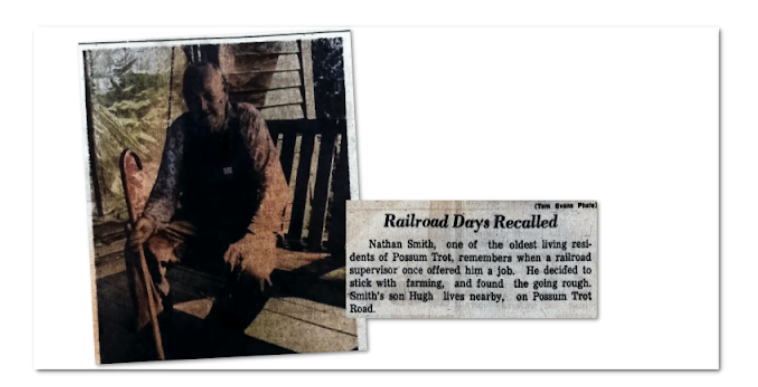
    **Caption: Nathan Smith, one of the oldest living residents of Possom Trot, remembers when a railroad supervisor once offered him a job. He decided to stick with farming, and found the going rough. Smith’s son Hugh lives nearby, on Possum Trot Road.

    THE ANNISTON STAR, FRIDAY, NOVEMBER , 1968
    ‘Tot’ Smith’s Seen It All ‘Come And Go’
    By: Tom King
    SIXTH OF A SERIES

    **You may leave a virtual flower for Mr. Smith and learn more about him on his Find-a-Grave page here. 
  • Alabama Type,  Peculiar and Funny

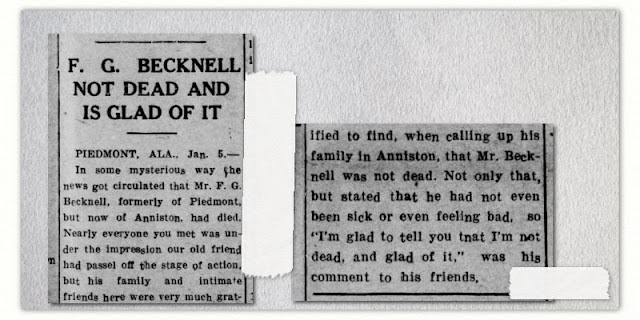
    F.G. BECKNELL NOT DEAD AND IS GLAD OF IT PIEDMONT, ALA. , Jan. 5.

    In some mysterious way the news got circulated that Mr. F.G. Becknell, formerly of Piedmont, but now of Anniston, had died. Nearly everyone you met was under the impression our old friend had passed off the stage of action, but his family and intimate friends here were very much gratified to find when calling up his family in Anniston, that Mr. Becknell was not dead. Not only that, but stated that he had not even been sick or even feeling bad, so “I’m glad to tell you that I’m not dead, and glad of it,” was his comment to his friends.


    F.G. BECKNELL NOT DEAD AND IS GLAD OF IT
    PIEDMONT, ALA. , Jan. 5.

    THE JACKSONVILLE RECORD, FRIDAY, JANUARY, 1933

  • Alabama Type

    News about Brother Edmond Roberts, Spring Garden, 1889


    THE COOSA RIVER NEWS, AUGUST, 1889

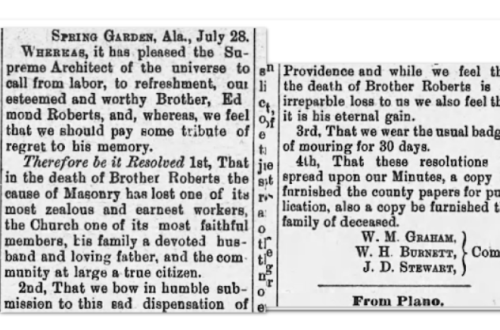
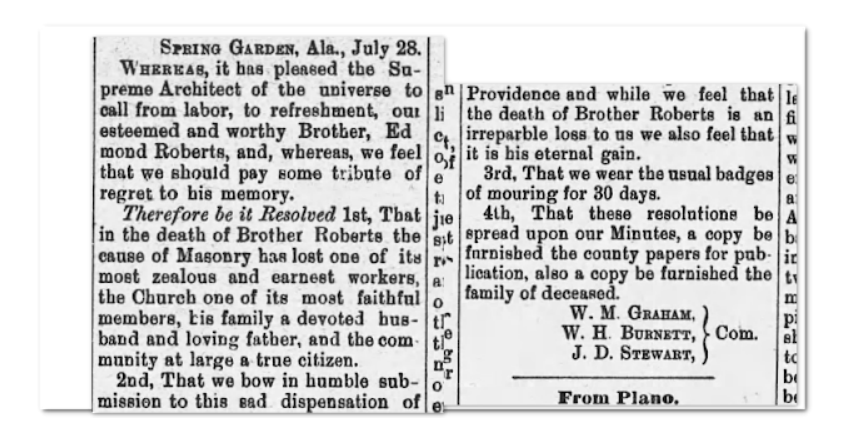
    SPRING GARDEN, ALa., July 28.

    WHEREAS, it has pleased the Supreme Architect of the universe to call from labor, to refreshment, our esteemed and worthy Brother, Edmond Roberts, and, whereas, we feel that we should pay some tribute of regret to his memory.
    Therefore be it Resolved 1st, That in the death of Brother Roberts the cause of Masonry has lost one of its most zealous and earnest workers, the church one of its most faithful members, his family a devoted husband and loving father, and the community at large a true citizen.
    2nd, That we bow in humble submission to this sad dispensation of Providence and while we feel that the death of Brother Roberts is an irreparable loss to us we also feel that it is his eternal gain.
    3rd, That we wear the usual badges of mouring for 30 days.
    4th, That these resolutions be spread upon our Minutes, a copy be furnished the county papers for publication, also a copy be furnished the family of deceased.

    W.M. GRAHM, W.H. BURNETT, J.D. STEWART, com.