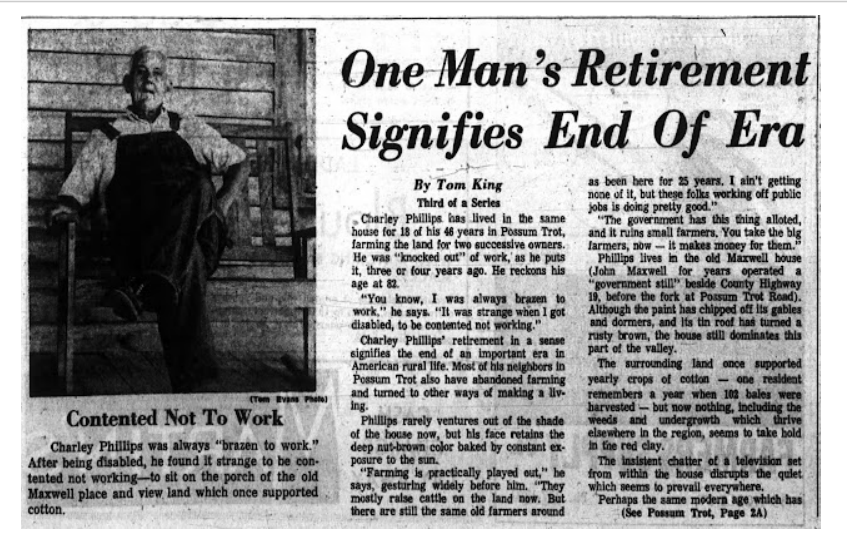
Charley Phillips has lived in the same house for 18 of his 46 years in Possum Trot, farming the land for two successive owners. He was “knocked out” of work, as he puts it, three or four years ago. He reckons his age is 82.
“You know, I was always brazen to work,” he says. “It was strange when I got disabled, to be contented not working.”
Charley Phillips’ retirement in a sense signifies the end of an important era in American rural life. Most of his neighbors in Possum Trot, also have abandoned farming and turned to other ways of making a living.
Phillips rarely ventures out of the shade of the house now, but his face retains the deep nut-brown color baked by constant exposure to the sun.
“Farming is practically played out,” he says, gesturing widely before him. “They mostly raise cattle on the land now. But there are still the same old farmers around as been here for 25 years. I ain’t getting none of it, but these folks working off public jobs is doing pretty good.”
“The government has this thing allotted, and it ruins small farmers. You take the big farmers, now–it makes money for them.”
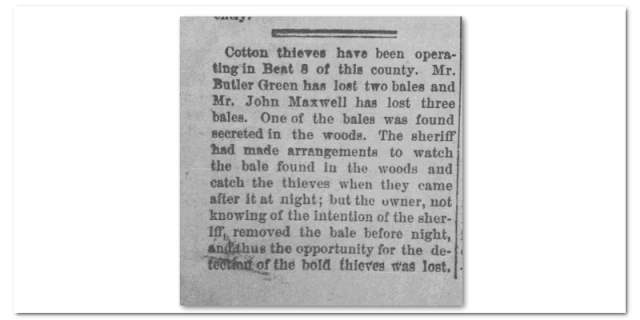
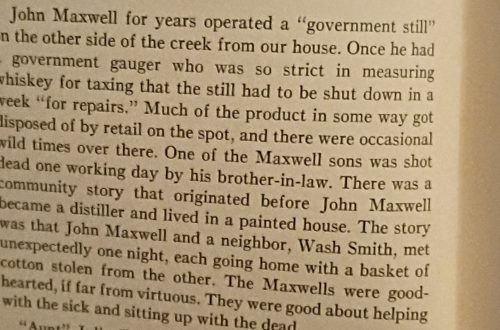
Phillips lives in the old Maxwell house (John Maxwell for years operated a “government still” beside County Highway 19, before the fork at Possum Trot Road). Although the paint has chipped off its gables and dormers, and its tin roof has turned a rusty brown, the house still dominates this part of the valley.
The surrounding land once supported yearly crops of cotton–one resident remembers a year when 102 bales were harvested–but now nothing, including the weeds and undergrown which thrive elsewhere in the region, seems to take hold of the red clay.
The insistent chatter of a television set from within the house disrupts the quiet which seems to prevail everywhere.
Perhaps the same modern age which has outmoded Charley Phillips’ way of getting a living has also invented devices which make it easier “to be contented not working”.
One of the few small farms left in Possum Trot belongs to Lloyd Kiker, whose income still consists mainly of the salary he earns as an employee of the county board of education.
The life of his family curiously combines the old and new in Possum Trot–the farm-oriented society of three decades ago, and the city-oriented society of today.
THE ANNISTON STAR, NOVEMBER, 1968
One Man’s Retirement Signifies End of Era By: Tom King