• Alabama Type

    A Note from Union, 1876

    UNION.

    Mr. Editor: After a protracted drought of about five weeks, the copious showers of rain which have fallen here the past week have had a magical effect upon the growing crops, which were not materially injured by the dry spell, owing to their having been thoroughly cultivated. We believe in stirring the soil in this section, as the best protection against the evil effects of drouth. Our wheat crop was not all that we had hoped for it. In the language of the poet, it was “too thin”. We had to scare it up in the fence corners to cut it with scissors.

    We are glad to announce that a new industry has sprung up in our neighborhood, that of gathering blackberries for market. Dr. L. I am told has many hands employed to fill a large order from Oxford. Owing to the stringency of times, I understand they are in great demand at that place.

    Once of your fellow townsmen, Mr. Cave, is in his vicinity painting the dwelling house of Mr. Loyd. He is putting the “city agony” on it. I have heard from the Peeks Hill “localist”. He has gone into the manufacture of poetry. He fills orders for all kinds at factory prices, viz” 3c per yd. He has doubtless struck his talent now. I congratulate him upon his success.
    XX.


    JACKSONVILLE REPUBLICAN, SAT, JUNE 24, 1876
  • Alabama Type

    Heroic Act of Emmet Calhoun, age 9, 1905

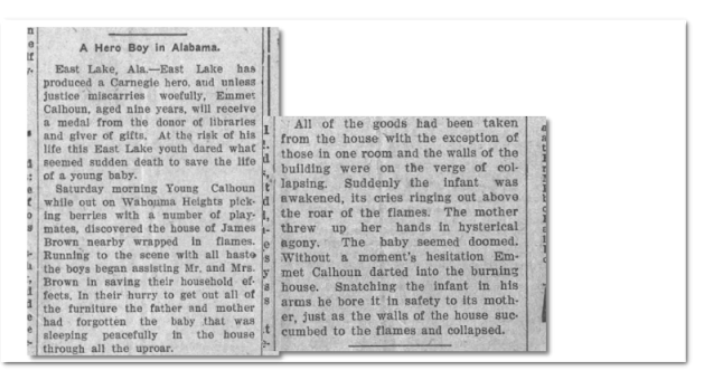
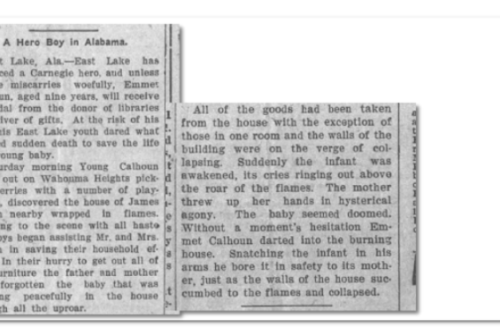
    A Hero Boy in Alabama.

    East Lake, Ala.–East Lake has produced a Carnegie hero, and unless justice miscarries woefully, Emmet Calhoun, aged nine years, will receive a medal from the honor of libraries and giver of gifts. At the risk of his own life this East Lake youth dared what seemed sudden death to save the life of a young baby.

    Saturday morning Young Calhoun while out on Wahouma Heights picking berries with a number of playmates, discovered the house of James Brown nearby wrapped in flames. Running to the scene with all haste the boys began assisting Mr. and Mrs. Brown in saving their household effects. In their hurry to get out all of the furniture the father and mother had forgotten the baby that was sleeping peacefully in the house through all the uproar.

    All of the goods had been taken from the house with the exception of those in one room and the walls of the building were on the verge of collapsing. Suddenly the infant was awakened, its cries ringing out above the roar of the flames. The mother threw up her hands in hysterical agony. The baby seemed doomed. Without a moment’s hesitation, Emmet Calhoun darted into the burning house. Snatching the infant in his arms he bored it in safety to its mother, just as the walls of the house succumbed to flames and collapsed.

    THE OPP HUSTLER, FRIDAY, 1905

  • Alabama Type,  In Memory

    Sad Death of Lawrence Journey, Jacksonville, 1903

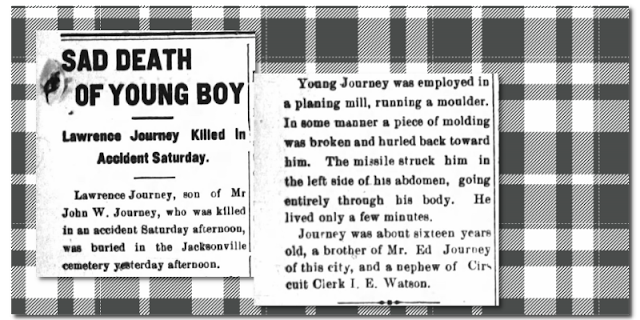
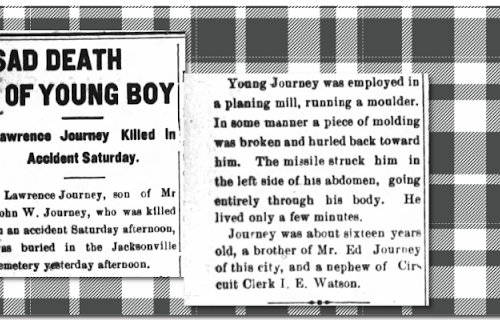
    SAD DEATH OF YOUNG BOY

    Lawrence Journey Killed in Accident Saturday.

    Lawrence Journey, son of Mr. John W. Journey, who was killed in an accident Saturday afternoon, was buried in the Jacksonville Cemetery yesterday afternoon.
    Young Journey was employed in a planing mill, running a moulder. In some manner, a piece of molding was broken and hurled back toward him. The missile struck him in the left side of his abdomen going entirely through his body. He lived only a few minutes.
    Journey was about sixteen years old, a brother of Mr. Ed Journey of this city, and a nephew of Circuit Clerk I.E. Watson.


    THE ANNISTON REPUBLIC, SATURDAY, SEPTEMBER 19TH, 1903

  • Alabama Type

    Sunday Afternoon Blaze, Piedmont, 1891

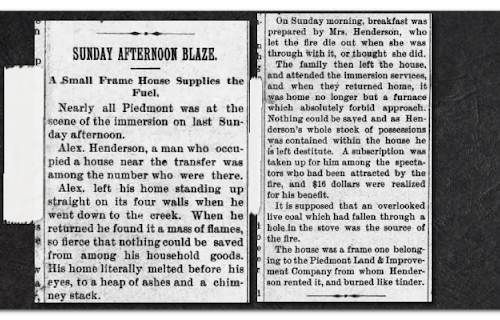
    SUNDAY AFTERNOON BLAZE.

    A Small Frame House Supplies the Fuel.

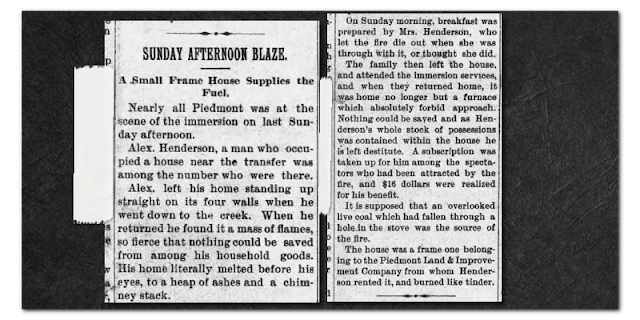
    Nearly all Piedmont was at the scene of the immersion on last Sunday afternoon.
    Alex Henderson, a man who occupied a house near the transfer was among the number who were there.
    Alex. left his home standing up straight on its four walls when he went down to the creek. When he returned he found it a mass of flames, so fierce that nothing could be saved from among his household goods. His home literally melted before his eyes, to a heap of ashes and a chimney stack.
    On Sunday morning, breakfast was prepared by Mrs. Henderson, who let the fire die out when she was through with it, or thought she did.
    The family then left the house, and attended the immersion services, and when they returned home, it was home no longer but a furnace which absolutely forbid approach. Nothing could be saved and as Henderson’s whole stock of possessions was contained within the house he is left destitute. A subscription was taken up for him among the spectators who had been attracted by the fire, and $16 dollars were realized for his benefit.
    It is supposed that an overlooked live coal which had fallen through a hole in the stove was the source of the fire.
    The house was a frame one belonging to the Piedmont Land & Improvement Company from whom Henderson rented it, and burned like tinder.

    PIEDMONT INQUIRER, SATURDAY OCTOBER 31, 1891

  • Alabama Type

    Child Snake Bitten, Roy Webb 1937

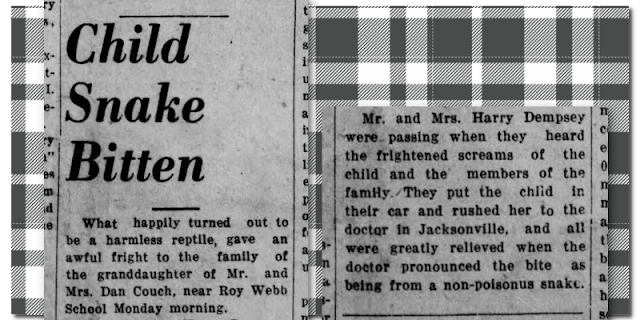
    Child Snake Bitten
    What happily turned out to be a harmless reptile, gave an awful fright to the family of the granddaughter of Mr. and Mrs. Dan Couch, near Roy Webb School Monday morning.
    Mr. and Mrs. Harry Dempsey were passing when they heard the frightened screams of the family. They put the child in their car and rushed her to the doctor in Jacksonville, and all were greatly relieved when the doctor pronounced the bite as being from a non-poisonus snake.


    THE JACKSONVILLE RECORD, FRIDAY, 1937

  • Alabama Type,  In Memory

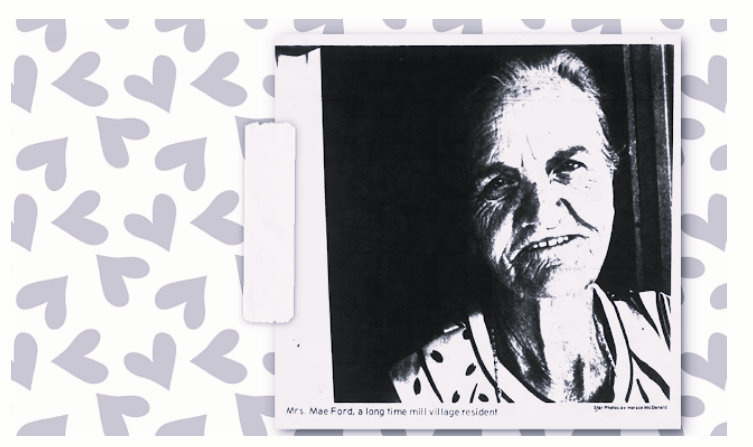
    Mrs. Mae Ford, Jacksonville 1977

    ‘Family’ feeling fading in Jacksonville’s mill area

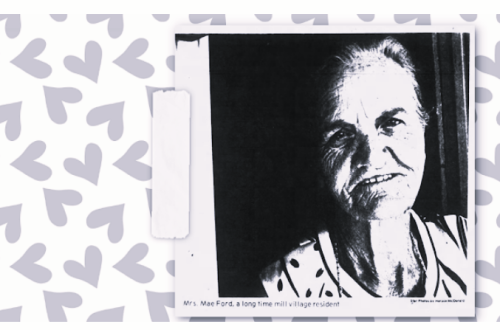
    Mrs. Mae Ford of 21 A St has lived in the village – to the west of the square and mostly down hill – more than 50 years.

    “I married here in the Methodist church in town and I’ve lived in number 4, 21, and 41,” she said “I’ve raised my family here and made my steps right in here.” the silver-haired woman said as she looked over some pictures of mill workers taken in 1906.
    “It’s the best neighborhood to live in,” she said “The older ones were just like a family. If one got in trouble, the others would go to help them.”

    Mrs. Ford raised six children in the village, not an unusual number for the 1930s and 1940s she said.

    “Everybody had five or six or seven children” she recalled “Nobody could afford anything for Christmas except for a red wagon for the whole family.
    “There’re no children around anymore.”

    Mrs. Ford worked in the Profile Cotton Mill for 34 years before she quit in 1955. “I spooled for 14 years. I also was an extra. I worked wherever they needed me. I’ve done everything in all the mills.”

    Mrs. Ford said living in a company-owned house was convenient.

    “It was close and handy,” she said “I could run out when I’d catch up with my work and check on my children. It was a good settlement.”

    Living in the village was also economical.
    Mrs. Ford worked when the company had an order and usually brought home $32 a month. Her late husband who also worked at the mill, made less than that for years she said.
    From their earnings, they paid the company $4.80 a month in rent and bought groceries at the Profile Store on B Street.
    What they didn’t buy, they raised in gardens, hog pens and company-owned cow pastures.

    “I just had a few tomatoes and cucumbers this year,” Mrs. Ford said. “When you get 74, it’s time to slow down. I still cut my grass though, and walk to town and church.”

    Also featured in the article:
    Jud Harrelson of 54 B st, James Jocko Martin of 1 A st, James Harbin of 94 c st, Mrs. Bertha Barnwell of 116 D st, Treda Bonds of 55 B st, Sandy Barnwell of 44 B st.

    THE ANNISTON STAR, 77 (Monde Murphy) Excerpt

  • Alabama Type

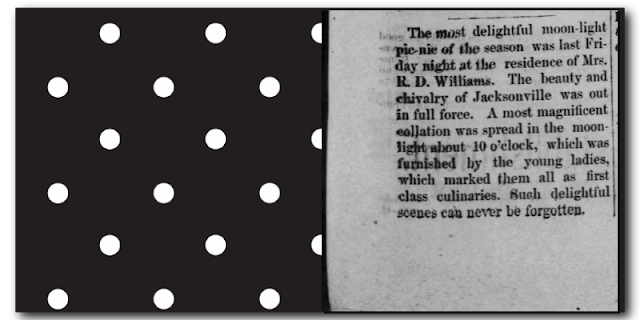
    Moonlight Picnic, Jacksonville, 1884

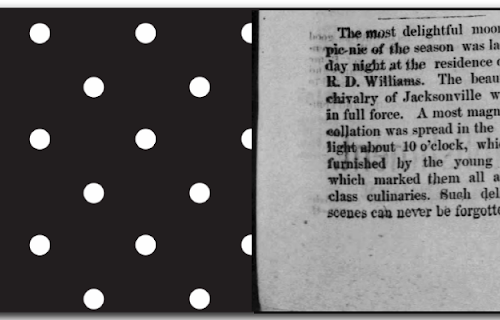
    The most delightful moon-light pic-nic of the season was last Friday night at the residence of Mrs. R.D. Williams. The beauty and chivalry of Jacksonville was out in full force. A most magnificent collation was spread in the moonlight about 10 o’clock, which was furnished by the young ladies, which marked them all as first class culinaries. Such delightful scenes can never be forgotten.


    JACKSONVILLE REPUBLICAN SATURDAY SEPTEMBER, 1884

  • Alabama Type,  Peculiar and Funny

    A Horse Scrape, 1889, Oxford

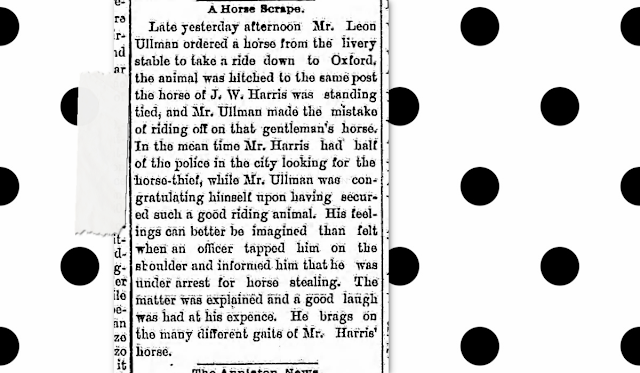
    A Horse Scrape.
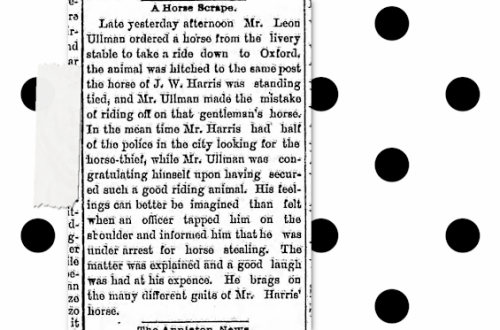
    Late yesterday afternoon Mr. Leon Ullman ordered a horse from the livery stable to take a ride down to Oxford. The animal was hitched to the same post the horse of J.W. Harris was standing tied, and Mr. Ullman made the mistake of riding off on that gentleman’s horse.
    In the mean time Mr. Harris had half of the police in the city looking for the horse-thief, while Mr. Ullman was congratulating himself upon having secured such a good riding animal. His feelings can better be imagined than felt when an officer tapped him on the shoulder and informed him that he was under arrest for horse stealing. The matter was explained and a good laugh was had at his expence. He brags on the many different gaits of Mr. Harris’ horse.


    THE EVENING NEWS, THURSDAY, MARCH 21, 1889

  • Alabama Type

    Little Girl is Rescued from Well, Williams, 1930

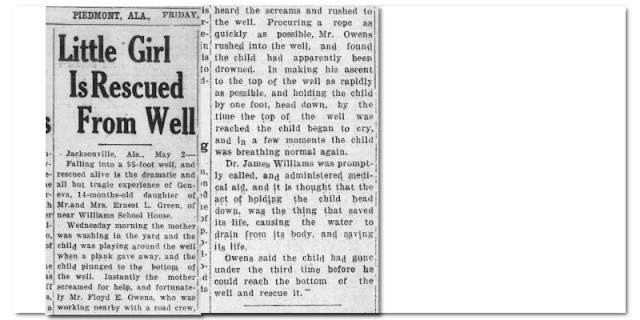
    Little Girl Is Rescued From Well

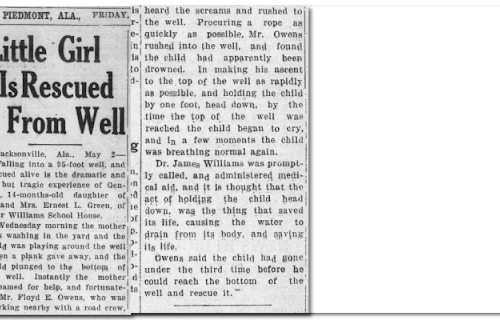
    Jacksonville, Ala., May 2– Falling into a 95-foot well, and rescued alive is the dramatic and all but tragic experience of Geneva, 14-months-old daughter of Mr. and Mrs. Ernest L. Green of near Williams School House.
    Wednesday morning, the mother was washing in the yard and the child was playing around the well when a plank gave away, and the child plunged to the bottom of the well. Instantly the mother screamed for help, and fortunately Mr. Floyd E. Owens, who was working nearby with a road crew, heard the screams and rushed to the well. Procuring a rope as quickly as possible, Mr. Owens rushed into the well, and found the child had apparently been drowned. In making his ascent to the top of the well as rapidly as possible, and holding the child by one foot, head down, by the time the top of the well was reached the child began to cry, and in a few moments the child was breathing normal again.
    Dr. James Williams was promptly called, and administered medical aid, and it is thought that the act of holding the child head down was the thing that saved its life, causing the water to drain from its body and saving its life.
    Owens said the child had gone under the third time before he could reach the bottom of the well and rescue it.


    PIEDMONT JOURNAL FRIDAY MAY, 1930

  • Alabama Type,  In Memory

    Catastrophe Strikes Twice, 1871

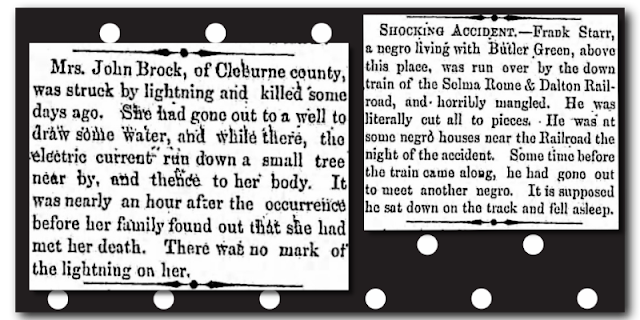
    Mrs. John Brock of Cleburne county, was struck by lightning and killed some says ago. She had gone out to a well to draw some water, and while there, the electric current run down a small tree near by, and thence to her body.It was nearly an hour after the occurrence before her family found out that she had met her death. There was no mark of lightning on her.

    SHOCKING ACCCIDENT. –Frank Starr, a negro living with Butler Green, above this place, was run over by the down train of the Selma Rome & Dalton Railroad, and horribly mangled. He was literally cut all to pieces. He was at some negro houses near the Railroad the night of the accident. Some time before the train came along, he had gone out to meet another negro. It is supposed he sat down on the track and fell asleep.


    JACKSONVILLE REPUBLICAN SATURDAY AUGUST 19, 1871