• Alabama Type,  In Memory

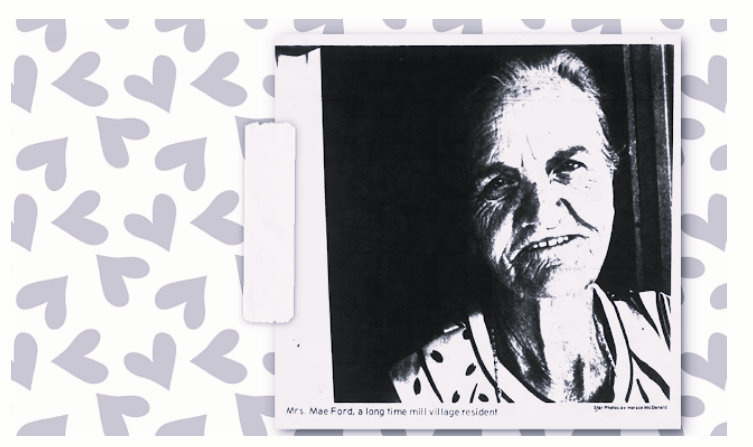
    Mrs. Mae Ford, Jacksonville 1977

    ‘Family’ feeling fading in Jacksonville’s mill area

    Mrs. Mae Ford of 21 A St has lived in the village – to the west of the square and mostly down hill – more than 50 years.

    “I married here in the Methodist church in town and I’ve lived in number 4, 21, and 41,” she said “I’ve raised my family here and made my steps right in here.” the silver-haired woman said as she looked over some pictures of mill workers taken in 1906.
    “It’s the best neighborhood to live in,” she said “The older ones were just like a family. If one got in trouble, the others would go to help them.”

    Mrs. Ford raised six children in the village, not an unusual number for the 1930s and 1940s she said.

    “Everybody had five or six or seven children” she recalled “Nobody could afford anything for Christmas except for a red wagon for the whole family.
    “There’re no children around anymore.”

    Mrs. Ford worked in the Profile Cotton Mill for 34 years before she quit in 1955. “I spooled for 14 years. I also was an extra. I worked wherever they needed me. I’ve done everything in all the mills.”

    Mrs. Ford said living in a company-owned house was convenient.

    “It was close and handy,” she said “I could run out when I’d catch up with my work and check on my children. It was a good settlement.”

    Living in the village was also economical.
    Mrs. Ford worked when the company had an order and usually brought home $32 a month. Her late husband who also worked at the mill, made less than that for years she said.
    From their earnings, they paid the company $4.80 a month in rent and bought groceries at the Profile Store on B Street.
    What they didn’t buy, they raised in gardens, hog pens and company-owned cow pastures.

    “I just had a few tomatoes and cucumbers this year,” Mrs. Ford said. “When you get 74, it’s time to slow down. I still cut my grass though, and walk to town and church.”

    Also featured in the article:
    Jud Harrelson of 54 B st, James Jocko Martin of 1 A st, James Harbin of 94 c st, Mrs. Bertha Barnwell of 116 D st, Treda Bonds of 55 B st, Sandy Barnwell of 44 B st.

    THE ANNISTON STAR, 77 (Monde Murphy) Excerpt
  • Alabama Type,  In Memory

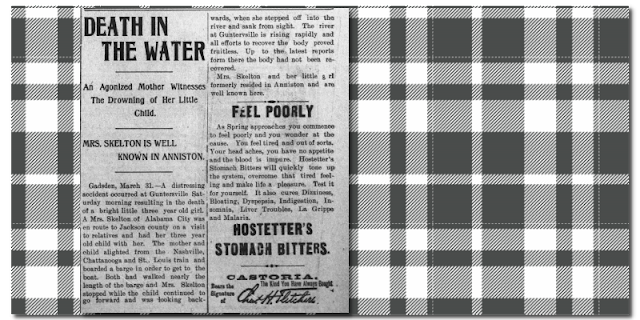
    Death in the Water, Jacksonville, 1904

    An Agonized Mother Witnesses The Drowning of Her Little Child

    MRS. SKELTON IS WELL KNOWN IN ANNISTON

    Gadsden, March 31. A distressing accident occurred at Guntersville Saturday morning resulting in the death of a bright little three year old girl. A Mrs. Skelton of Alabama City was en route to Jackson county on a visit to relatives and had her three year old child with her. The mother and child alighted from the Nashville, Chattanooga, and St. Louis train and boarded a barge in order to get to the boat. Both had walked nearly the length of the barge and Mrs. Skelton stopped while the child continued to go forward and was looking backwards, when she stepped off into the river and sank from sight. The river at Guntersville is rising rapidly and all efforts to recover the body proved fruitless. Up to the latest reports from there, the body had not been recovered.
    Mrs. Skelton and her little girl formerly resided in Anniston and are well known here.


    THE ANNISTON STAR FRIDAY APRIL, 1904
    DEATH IN THE WATER

  • Alabama Type

    Tom Couch, Salem Church, Possum Trot, 1968

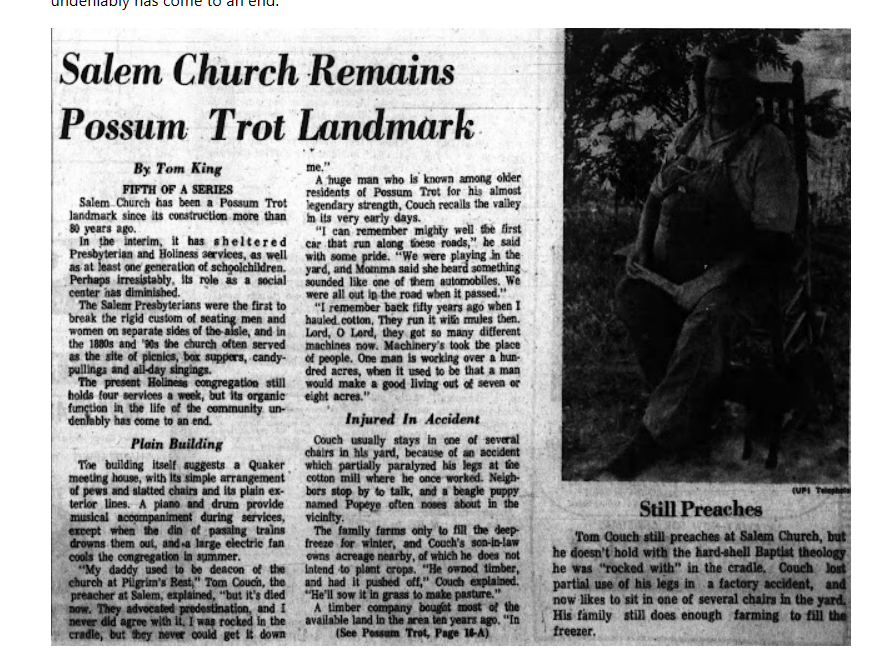
    Salem Church has been a Possum Trot landmark since its construction more than 80 years ago.
    In the interim, it has sheltered Presbyterian and Holiness services, as well as at least one generation of schoolchildren. Perhaps irresistible, its role as a social center has diminished.
    The Salem Presbyterians were the first to break the rigid custom of seating men and women on separate sides of the aisle, and in the 1880s and ’90s the church often served as the site of picnics, box suppers, candy-pullings and all-day singing.
    The present Holiness congregation still holds four services a week, but this organic function in the life of the community undeniably has come to an end.

    Plain Building
    The building itself suggests a Quaker meeting house, with its simple arrangement of pews and slatted chairs and its plain exterior lines. A piano and drum provide musical accompaniment during services, except when the din of passing trains drowns them out, and a large electric fan cools the congregation in summer.

    “My daddy used to be a deacon of the church at Pilgrim’s Rest,” Tom Couch, the preacher at Salem, explained, “but it’s died now. They advocated predestination, and I never did agree with it. I was rocked in the cradle, but they never could get it down me.”

    A huge man who is known among older resides of Possum Trot for his almost legendary strength, Couch recalls the valley in its very early days.

    “I can remember mighty well the first car that run along these roads,” he said with some pride. “We were playing int he yard, and Momma said she heard something sounded like one of them automobiles. We were all out in the road when it passed.”
    “I remember back fifty years ago when I hauled cotton. They run it with mules then. Lord, O Lord, they got so many different machines now. Machinery’s took the place of people. One man is working over a hundred acres when it used to be that a man would make a good living out of seven or eight acres.”

    Injured In Accident
    Couch usually stays in one of several chairs in his yard, because of an accident which partially paralyzed his legs at the cotton mill where he once worked. Neighbors stop by to talk, and a beagle puppy named Popeye often noses about in the vicinity.
    The family farms only to fill the deep freeze for winter, and Couch’s son-in-law owns acreage nearby, of which he does not intend to plant crops.

    “He owned timber and hade it pushed off,” Couch explained. “He’ll sow it in grass to make a pasture.”
    A timber company bought most of the available land in the area ten years ago. “In a lot of the country where there used to be people, thick with settlers, there are hardly any now,” he said.
    “It’s strange for companies to own land that people used to own.”
    Apt summaries of the most heart heartbreaking changes that have come to Possum Trot: “Machinery’s took the place of people,” and “It’s strange for companies to own land that people used to own.”


    Still Preaches
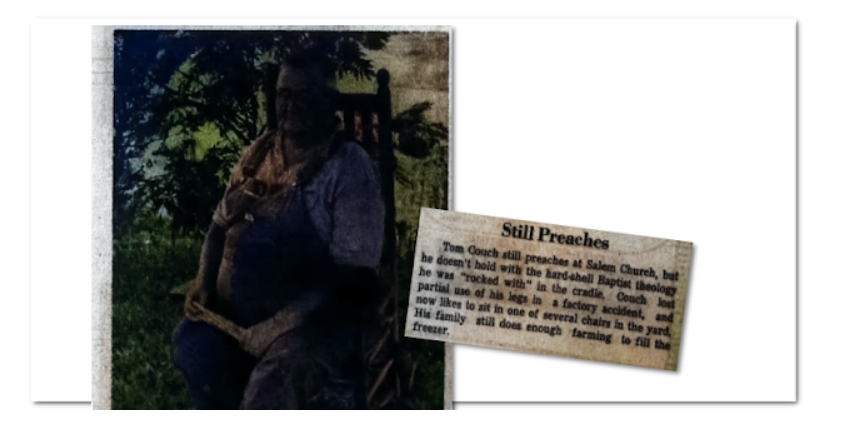
    Tom Couch still preaches at Salem Church, but he doesn’t hold with the hard-shell Baptist theology he was “rocked with” in the cradle. Couch lost partial use of his legs in a factory accident, and now likes to sit in one of several chairs in the yard. His family still does enough farming to fill the freezer.


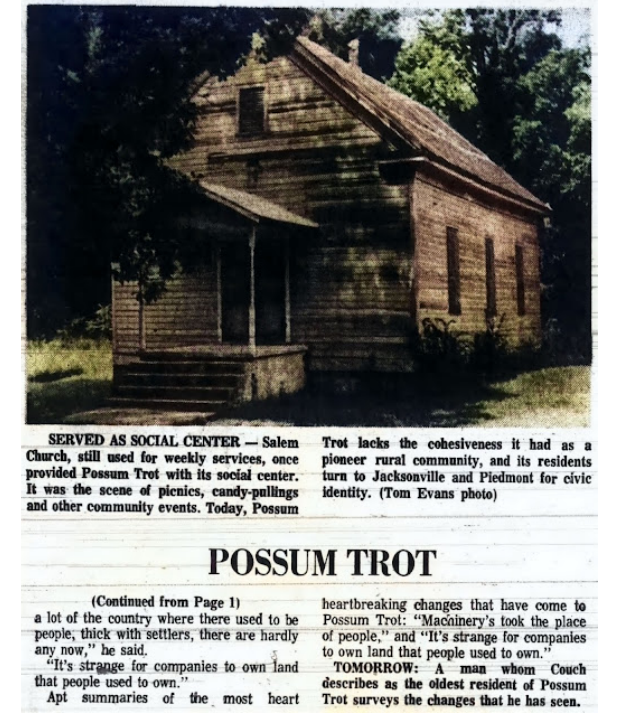
    SERVED AS SOCIAL CENTER– Salem Church, still used for weekly services, once provided Possum Trot with its social center. It was the scene of picnics, candy-pullings and other community events. Today, Possum Trot lacks the Cohesiveness it had as a pioneer rural community, and its residents turn to Jacksonville and Piedmont for civic identity. (Tom Evans photo)

    THE ANNISTON STAR, THURSDAY NOVEMBER, 1968
    Salem Church Remains Possum Trot Landmark
    By: Tom King
    FIFTH OF A SERIES

  • Alabama Type

    1902 | The Duke of Merrellton, Jason Scott, suffered from granulated eyelids

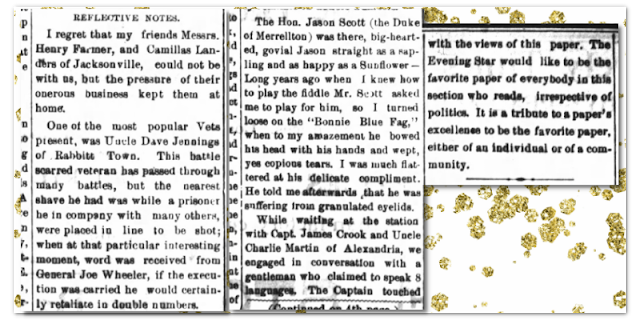
    I regret that my friends Messrs. Henry Farmer, and Camillas Landers of Jacksonville, could not be with us, but the presence of their onerous business kept them at home.

    One of the most popular Vets present, was Uncle Dave Jennings of Rabbitt Town. This battle scarred veteran has passed through many battles, but the nearest shave he had was while a prisoner he in company with many others, were placed in line to be shot; when at that particular interesting moment, word was received from General Joe Wheeler, if the execution was carried he would certainly retaliate in double numbers.

    The Hon. Jason Scott (the Duke of Merrellton) was there, big-hearted, govial Jason straight as a saplling and as happy as a sunflower–
    Long years ago when I knew how to play the fiddle Mr. Scott asked me to play for him, so I turned loose on the “Bonnie Blue Flag,” when to my amazement he bowed his head with his hands and wept, yes copious tears. I was much flattered at his delicate compliment. He told me afterwards that he was suffering from granulated eyelids.

    While waiting at the station with Capt. James Crook and Uncle Charlie Martin of Alexandria, we engaged in conversation with a gentleman who claimed to speak 8 languages. The captain touched with the views of this paper. The Evening Star would like to be the favorite paper of everybody in this section who reads, irrespective of politics. It is a tribute to a paper’s excellence to be the favorite paper, either of an individual or of a community.


    THE ANNISTON STAR, WEDNESDAY, AUGUST,1902
    An excerpt, notes from Camp Forney Veteerans’ Reunion, REFLECTIVE NOTES.

    ***In case you’ve never heard ‘My Bonnie Blue Flag’, you can listen to one version of it here.